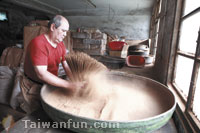
The sticks are patted and
spread out like a fan after
being sprinkled with powder.
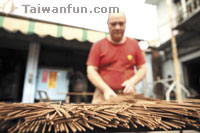
The just-finished incense is
very soft, so makers must be
very careful when sun-drying
them.
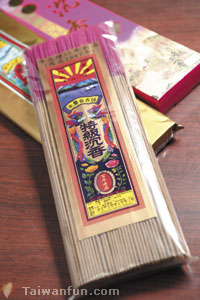
The highest-quality incense
can be 10 times more
expensive than inferior
varieties because of the raw
materials that are used.
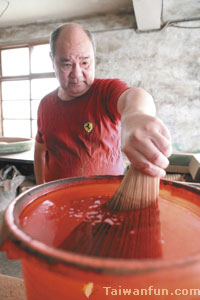
The first step for making
incense is to dampen the
incense sticks.
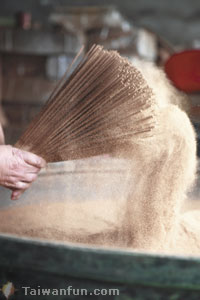
The hardest part of making
incense is evenly spreading
the powder on the sticks.
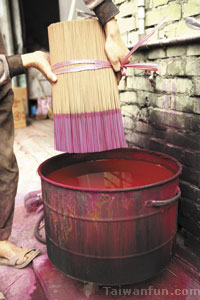
The lower ends of the sticks
are dyed a cheerful, bright red
color.
|
Daya district's Zhu Qing-chun Incense Shop
Sincerity and piety are the keys to a century-old business.
Words by Ye Jia-hui
Photography by You Jia-huan
Translated by Angel Pu
Despite the fact that he's 65, Zhu Du-sheng, the fourth-generation owner of
Zhu Qing-chun Incense Shop, still gets up very early for work. Using natural
ingredients, he makes all of his high-quality incense by hand, believing that
this is a way of showing respect to Buddha and other deities.
In just a couple minutes, the sunny skies turned cloudy and it started to sprinkle, making the incense maker nervous as he hurried the photographer taking pictures of him drying his products. After these were taken, he immediately and carefully moved the soft, fragile incense into a warehouse.
"Weather is the most important element for us incense makers," said Bao-yu, wife of the Zhu Qing-chun Incense Shop's fifth generation. Glancing at the sky, she continued, "[The weather] only gets more and more unstable before the Chinese New Year, and our only solution is to prepare the stock as early as possible. We cannot let down the customers who come to buy our incense."
Incense-making never an easy job
Located in Taichung's Daya district, Zhu Qing-chun Incense Shop is a famed local business that was founded in 1887. The 65-year-old Zhu Du-sheng is the store's fourth-generation owner and could be playing with his grandchildren, enjoying life after retirement. However, he would rather stay in the factory, filled with dust and dyes from incense production. When asked whether his trade is hard work, Zhu just smiles and says, "Of course it's a very, very hard job. You have to stay outside in the most difficult weather, and you have to stay up early everyday. I don't think there are many people who can bear those difficulties."
He then recounts the shop's origins. In the beginning, the large Zhu family made its living selling Chinese Fried Cakes in front of their home, but it was tough for them to survive on this tiny income. Zhu Xin-quan, the first owner, figured that he could open an incense shop because their house was near a temple, so he hired some incense makers and started the business, which today is over 100 years old.
When the shop was passed down to Zhu Shui, son of Zhu Xin-quan, he decided to learn incense-making techniques himself. Moreover, in order to sell more products to more people, Zhu Shui even began carrying the incense on a shoulder pole to different towns. After the fifth-generation Zhu Du-sheng finished elementary school, he began learning techniques for making incense from scratch. Now, following 50 years of constant improvements, he knows everything about incense, and can tell a product's quality just by smell and appearance. He deeply understands every stop of the production process, from ordering the materials and mixing Chinese medicines to making the incense. "Incense is used to worship Buddha, so you can't be too careful about the production," he notes.
Weather forecasting ability a job requirement
The first thing one needs when learning to make incense is gaining insights into the weather. According to Zhu Du-sheng's daughter-in-law Bao-yu, his ability to forecast the weather is even more accurate than the Central Weather Bureau. He can tell what the weather will be that day just by looking at the clouds and the color of the sky. If it's sunny, incense makers will start working at 4 o'clock in the morning and get everything done before 6 or 7 a.m. so that the incense can be sun-dried. It is then collected before the sun goes down, and the sticks are dyed the next day.
According to Bao-yu, it's not extremely complicated to make incense, although experience is needed to complete every step. The first priority is to select a good-quality stick material, usually two-year-old bamboo for its flexibility. About a third of the stick is kept for handling, and the rest is dipped into water. The next step is very important: When the stick is removed from the water, one must be sure that it has been evenly soaked. However, doing this too slowly will effect the following procedures, and eventually all sticks in the batch will have to be thrown away.
Next, the wet sticks are covered in a mixture of various Chinese medicines, agilawood powder, sandalwood powder and cedar tree bark powder. Zhu expertly spreads the powder on three kilos of sticks. Holding the sticks together, he then shakes them properly in order to make the powder evenly adhere. After spreading on another layer of powder, he starts to pat them while holding the bunch like a fan. The above procedures have to be done three or four times to ensure the quality of each stick. According to Bao-yu, one ingredient they usually add into the mixture is sorghum liquor, because the alcohol draws out the aromas of the powder. Since 90 percent of Taiwan sorghum is produced in Daya district, using this liquor is an ideal solution.
Work must go on, even in hard times
After the powder has adhered to the sticks, they are very fragile and the powder will only stay on after being sun- and air-dried. It also takes skill to move the sticks under the sun as customers do not like these to be broken or damaged. After about half a day of drying, the workers will start dyeing the lower part of the incense sticks the following day.
Those who have worshipped in a temple before will certainly know that their fingers are often stained red after holding incense sticks. These stains are actually from a food coloring normally used in many traditional Chinese desserts. First, the incense makers boil a mixture of food coloring and water before placing the lower end of the sticks into the liquid and and sun-drying for a whole day. This completes all major production steps, with the only remaining task being picking out poor-quality sticks and packaging the rest.
According to Zhu, it normally takes three and a half years to become a professional incense maker. He recalls that while he was learning these techniques, his grandfather always told him it was very important to make incense with great respect for the deities. The best-known feature of the Zhu Qing-chun Incense Shop is its insistence on using a secret formula containing over 20 kinds of Chinese medicines and handed down through the family instead of synthetic, chemical fragrances. You can certainly discern this quality through the mild aroma and gentle smoke that these sticks emit.
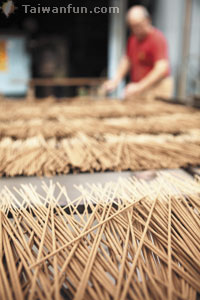 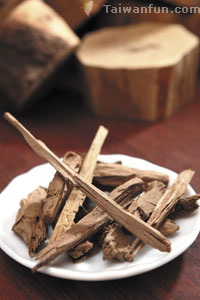
Left: The incense needs to be sun-
dried for an entire day in order
to unfold the sticks like a fan.
Right: Because raw materials are very expensive, you
sometimes are unable to buy
good-quality incense even for
more money.
Only high-quality incense is not harmful to health
Taiwan's incense-making industry has faced serious challenges in recent times. A couple of years ago, due to China's cheaper wages and materials, most Taiwanese incense businesses began making products on the mainland, and incense shops began importing cheap Chinese incense to Taiwan. Because Chinese incense was four times cheaper than Taiwan's, people naturally began choosing cheaper products over high-quality ones. However, they failed to realize that the Chinese incense actually produced smoke that was harmful to the human body. "The Chinese do shoddy work and use inferior materials, unlike us, who have great skills and only use natural materials," said Zhu. In order to reduce costs, the Chinese use chemical fragrances to replicate the scents of sandalwood and agilawood. "This could affect your body if you smell these chemical compounds for too long," notes Zhu worriedly.
The main reasons this shop has continued for over a century are persistence, its work ethic and a sense of responsibility. Therefore, even though material prices are incredibly high, the shop still persists in hand-making its products with natural ingredients and a traditional formula. In a first for the local incense-making industry, they now are even open to tourists, in order to help visitors understand how precious these traditional skills and technique are. With such efforts, this shop's owners hope that this art will continue to spread like the smoke and fragrance of its fine products.
|

 January 2012
