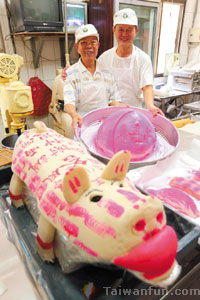
Chen Chin-chao and Chen
Chih-chang are each other's
best
assistants.
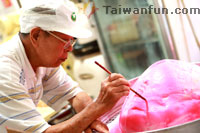
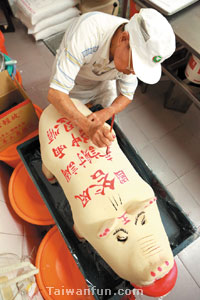
Chen Chin-chao focuses while
writing the word "longevity"
on a big
birthday bun.
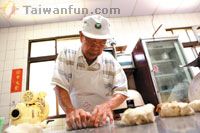
Because of reduced gluten
content, kneading Fengpian
Cakes
can be really
exhausting.
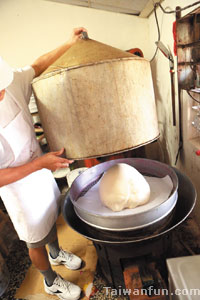
"Mother and son" Chinese
birthday buns have
to be steamed in extra-large
steamers.

The old Chuan Hsiang Chen
Cake Shop has a
collection of all sorts of antique
cake-making utensils.
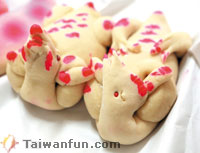
Fengpian Cake chickens and
ducks are very true-to-life.
|
Honoring the gods
with deep reverence: A father-and-son worship
cake business
Words by Ye Jia-hui
Photography by You Jia-huan
Translated by Angel Pu
Located in Taichung's Qingshui district, the 60-year-old Chuan Hsiang Chen cake shop operated by Chen Chin-chao and his son, Chen Chih-chang. When talking about the origins of the shop, the elder Chen says that one of his uncles initially learned cake-making skills before teaching other family members. His uncles then began opening their own cake shops in different places around Taiwan. Chen Chin-chao quite naturally learned his cake-making skills from his father and started working for his family at a very early age.
Later, Chen's own shop thrived and progressively grew, due to the fact that Taiwanese traditionally love to give gifts during festivals and holidays. This includes many kinds of cakes such as wedding cakes, festival cakes, moon cakes, and Chinese birthday buns. Over six decades, Chen has devoted his best years to the shop, as his delicious pastries have served as a means for customers to worship and thank the gods.
An irreplaceable religious tradition
Although it is increasingly obvious that Taiwan's traditional cake industry has been going downhill, Chen Chih-chang still thinks that his kind of business will never disappear if Taiwanese still worship their gods. Culturally speaking, traditional cakes stand for the humble and genuine reverence of Taiwanese worshipers, and their symbolism cannot be replaced by modern Western-style cakes.
"In the old days, the opportunity to eat meat among normal Taiwanese was really rare, and killing chickens and pigs as sacrifices to the gods expresed worshipers' reverence," he explains. "However, as time passed, people started to think that killing animals for worship violated the gods' grace and mercy, so they began using rice and flour to make pastries that looked like animals, such as chickens, ducks and pigs." Illustrating this fact, during this interview the shop received an order for a vegetarian pork cake from a customer wanting to show gratitude to gods for allowing his father to celebrate his 80th birthday in good health.
"Our products are preservative-free, so even if we already get an order earlier, we still have to make the cakes on the day of delivery or they will spoil before the customers can eat them," says Chen as he busies himself preparing ingredients. First, he combines fried glutinous rice flour with malt syrup and other cooking materials in a mixer, removes the mixture, and begins to fold and roll it repeatedly. This simple movement actually takes great deal of effort and strength, forcing Chen to use the weight of his upper body to roll the mixture as hard as he can. After going through these motions for a while, the mixture begins to look flat and smooth, the way a Fengpian Cake should be.
Seeking a compromise between two generations
"It's not complicated to make Fengpian Cakes, but it takes experience and the artistic skills of the cake maker to turn these into true to life sacrifices," says Chen Chih-chan. However, he adds that the vegetarian sacrifices cannot be too real, or people may feel scared. The cake makers usually add some twists to the details of a full-scale vegetarian sacrifice to make it look a bit cartoonish, so that it seems both realistic but is more interesting to look at. This results from a compromise between the 48-year-old son and 80-year-old father.
To make a vegetarian pork sacrifice, Chen Chin-chao first cuts out the "parts"---such as ears, limbs and tail--for a Fengpian Cake, before placing the left cake into a mold to make the body of the pig. There is no room for mistakes when making Fengpian Cake pig, so Chen is always quiet and focused when working. First, he pinches out a slightly-raised shape on the cake, punches two holes in it, and carves some horizontal lines on the top of the holes. Suddenly, the nose of the pig appears. Then he uses a scissors to make two cuts and stuff a preserved plum into each cut, creating the pig's eyes. After finishing its face, the next things he needs to do is to stitch on the ears, limbs and tail, and then draw eyelashes and patterns onto the body to make it more adorable. Because this Fengpian Cake pig is meant to show the customer's gratitude to the gods, there have to be some auspicious sayings written on it and a special "money stamp" chopped on the pig before the the Fengpian Cake pig is complete.
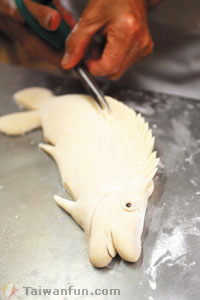 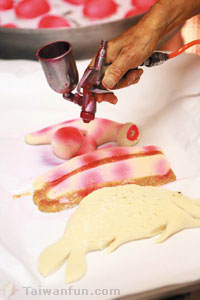
Left: Using a scissors technique,
realistic fish scales can be
created.
Right: Cakes look prettier with some
red food coloring sprayed on
them.
Ingenuity equals unique products
According to Chen Chin-chao, because Fengpian Cakes are made of fried glutinous rice flour, they don't need to be fermented, steamed or baked, and are immediately edible. However, fried glutinous rice flour requires more strength to knead and shape because its gluten content is not like flour's. Recalling the days when he was learning to knead, Chen Chih-chan says that he often had muscular pain because he didn't know the right way to do this. When eating Fengpian Cakes, the unique, sweet aroma they exude comes from banana oil, according to Chen Chih-chan. Adding this ingredient not only enhances the flavor, but also keeps away ants, which don't like the smell.
Normally, Fengpian Cake pigs are used for worshiping the Jade Emperor (ruler of heaven) while Fengpian Cake turtles are for worshiping deities. There are many kinds of vegetarian sacrifices, depending on who is being worshiped and what kind of wish/request the worshipers have. Chen Chin-chao has now completed an almost-65-kilogram cake turtle, which is three times bigger than the Fengpian Cake pigs he usually makes. Of course, it also took three times the effort to complete. In addition, during important days such as the Zhong Yuan Festival (commemoration of the dead), the birthdays of gods and goddesses, and Chinese New Year, the father-and-son team have to work overtime daily to meet deadlines. Though it is not an easy job, the duo are still happy to keep up their trade and pass along this bit of traditional culture. "All we need are the compliments of our customers," both of them say.
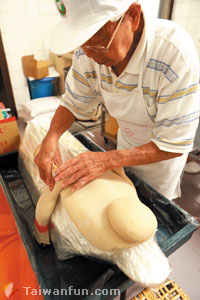 
Left: Chen Chin-chao uses water to stick parts onto
the cakes.
Right: Chen Chin-chao needs to be really focus when
writing sayings on his cakes, as there is no room
for mistakes.
|

 September 2012

