Legendary Fingertips
Hsu Jui-liang: 80 years
of dough sculpting
Words by Ye Jia-hui
Translated by Angel Pu
Photography by You Jia-huan
The artist uses his forefinger, middle finger and thumbs, molding
here and twisting there. After a moment, a little yellow duck
materializes in Grandpa Hsu Jui-liang's hand. "Just show grandpa
a picture and there's nothing he can't make!" remarks Wu Li-fen of
the Si-Shih Community Development Association.
"I remember a time from when I was little that I went to Taichung Park with my family," recalls Miss Wu. "The objects that I envied the most were the vividly-made dough sculptures in the hands of other kids. These sculptures were very detailed and had splendid colors, with each character's facial expression, hairstyle and clothing delicately created."
"The 'dough-sculptor grandpas' were superstars in those kids' hearts, as they watched them working with their fingers. How was it possible to made such a variety of little dolls and animals appear so suddenly? When we got our parents' permission to buy these 'luxury items'--made just for looks, not for eating--we experienced a joy and tremendous satisfaction that cannot be understood by today's children, who can get almost anything they want and whose fingers play with tablet computers until their eyes become hollow and bored."
In fact, dough sculptures were once made to be eaten. In more recent times, as people grew wealthier, these items gradually became toys made "just for looks" and visual appreciation. When he was little, Hsu Jui-liang followed his father everywhere as he displayed his dough creations. Consequently, he came to know and understand his father's passion for this traditional craft better than anyone. Hsu's use of this foundation to increase the artistry of dough sculpting has embodied the history of Taiwanese life and the transition of Taiwan's people from relative poverty to wealth.
  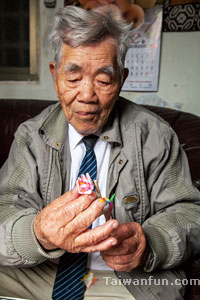
Left: Color matching is used to present the
characters' actions and movements are
among Hsu's unique skills.
Medium: Through the eyes of 90-year-old Hsu Jui-liang, cartoon
characters are given unique expressions of feeling.
Right: "If I've seen the picture, I can make it!"
Declares Hsu confidently regarding his
skills and creativity.
Unique Skill Inherited from Two Generations
This year, Grandpa Hsu Jui-liang reached his 90th year. He began studying dough-sculpting skills with his father from the age of 6. Back in those days, in the beginnings of Taiwan's economic blossoming, developing bread-winning skills was an absolute necessity. Towards this end, Hsu relied on the artistry that he inherited from his father, showing his own innate talents for correctly creating colors, lines and molds. At that time, this allowed him to earn a salary higher than a factory apprentice or laborer. Thus, dough sculptures allowed him to support his eight-person family. It was a poor, but simple and happy, era and existence that modern people--complaining about hard times but surrounded by fashion brands and boutiques--have a hard time understanding.
Hsu's creations are different from today's commonly-seen "dough sculptures", which are actually made with paper clay or resin. To make his sculptures, Grandpa Hsu uses a traditional "dough", specifically "rice dough", whose main ingredient is rice flour. After rice has been soaked and milled into a "rice milk", it is put into a bag that is tied up. This is then squeezed and left to dry with a heavy object sitting on top of it. A small portion of this rice flour dough is then put into boiling water to become "sticky rice dough", which is then kneaded with more rice flour dough until its surface becomes light and smooth. At this point, dough sculpting can begin.
When asked if this isn't just like the process for making 'tang yuan' (Chinese delicacy made from glutinous rice flour), Grandpa Hsu smiles and answers, "Right--but of course I have an exclusive method." For example, ensuring that the dough has the right texture is related to a proper balance between rice flour and water. Dough sculptures used to be edible in the past, so sculptors would put sugar into the rice flour, not only giving it a nice flavor but also serving as a preservative. Hsu notes that in poorer times, when there was a lack of daily necessities, dough sculptors didn't want to waste any ingredients. Therefore, besides sugar they sometimes added fillers like peanuts and red beans to the rice flour, making them children's favorites. However, in richer times, dough sculptures only serve as ornaments, so he mixes salt instead of sugar into the dough. The improved preservative effect of salt means that the sculptures also last longer.
In general, if no extra fillers are added to dough sculptures, they can last half a year. However, things are different when they are mounted on a stick, making them easier to admire and play with. The physical difference between the stick and rice dough will vary with the humidity and this difference in thermal expansion will cause the dough sculptures to crack and even split, often after only after 2-3 weeks.
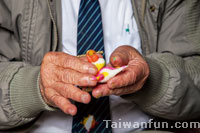 
Left: Twisting dough for many years has left 90-year-old Hsu
Jui-liang with fingers that are still skilled.
Right: Old-style, but very childlike, creativity is a defining feature of
Hsu Jui-liang's work.
Traditional molding and sculpting: It's all in the rice
As Wu Li-fen goes on to note, Grandpa Hsu Jui-liang isn't just a cultural treasure for his community, but also a Taiwanese treasure. Although there hasn't been any official research into this, there is the possibility that Hsu Jui-liang may be the only remaining creator of traditional dough sculptures left in Taiwan. Today, most dough sculptures seen at special events are made with paper clay and resin. If you take one apart, you'll see that most of these are have a single-geometry composition. Although they may appear cute and fun at first sight, they are made in a totally different way.
The rice dough used to make traditional sculptures requires a certain level of moisture and flexibility. Accumulated experience is also absolutely necessary for developing hand-molding skills. Grandpa Hsu's dough characters are mostly from traditional Chinese tales such as "Journey to the West" and "Eight Immortals". To vividly bring these characters' bright personalities and special appearances to life, he has to sculpt their facial characteristics and expressions and arrange their clothing and accessories to express more about their characters and story backgrounds in a lively fashion. The final results allow us to admire Xuanzang's Kasaya (robe for Buddhist monks and nuns) and wand, Zhu Bajie's nine-foot rake, or Lu Dongbin's elegant sleeves. Such details reveal the characters' backgrounds and stories, which Grandpa Hsu creatively illustrates through his imagination and skillful hands.
 
Left: "Journey to the West" and "Eight Immortals" are among traditional Chinese tales used as subjects for Hsu's creations.
Right: Rice dough, a tooth comb, scissors and plastic sticks--these simple tools bring
Hsu's imaginary world into reality.
Dynamic creativity via a single medium
In the past, because dough sculptures were edible, food coloring was used in their creation. Although Grandpa Hsu has never received any professional color theory training, his 90-year-old mind seems to flip like non-stop color cards, as he uses only red, yellow and blue as primary colors to create green, orange, purple and other colors in ever-changing hues and shades, some light and some soft. The layering of translucent rice dough during creation also means that different colors are stacked and may be different on the inside and outside, as Hsu uses white dough covered with green dough, or yellow dough mixed with red dough. If you use a scissors to cut open the dough, you may see that the while the surface is white, it is red inside, even as the yellow buds on the decorative flowers blossom vividly--if it wasn't for the whistling winds, these might make you almost forget it's a frigid winter.
In the past, one would often see Grandpa Hsu in crowded locations, making and selling dough sculptures. Businesses would also ask him to create a variety of fish and shrimp "kan-zhuo" sculptures (for offering display tables) for special occasions like Ghost Month, big weddings and funerals. However, with the passage of time and his age, he has retired from this regular work, meaning that his talents and skillful creations can only be observed at schools and other social organizations that have invited him to demonstrate his magical craftsmanship.
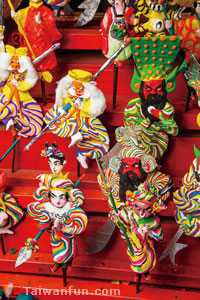
Left: Grandpa Hsu is already 90 years old, but
his eyes and hands remain steady as he
makes dough sculptures.
Right: Even when creating the same character, Hsu
is able to portray different styles, facial
expressions and looks.
"Last November, the Taichung Nursing Home invited Grandpa there to make dough sculptures. He was the oldest person there, but still witty and nimble," remarks Wu Li-fen with a smile. Because of Hsu's advanced age and the fact that an accidental fall has left him with an artificial hip joint, his family doesn't want him working too hard and has asked the Si-Shih Community Development Association to assist with rice dough making for his classes. This in turn helps pass along Grandpa Hsu's skills, as participants get to experience and understand first-hand that creating dough sculptures is not simply a matter of moving your fingers. Such traditional skills require physical strength, intelligence and a sense of aesthetic beauty.
Yongxin Leather Shoes
Address: 7, SanMin Rd, Sec 2, Central Dist., Taichung City
Tel:(04) 2221-0048
Hours:9 am-10 pm |

 March 2014
