Embroidering a
beautiful life: Kimono Embroidery
Artist Liu Qian-shao
Words by Ye Jia-hui Translated by Angela Cheng
Photography by Lu Da-zhong
"Even though you can enjoy an air-conditioned room without enduring changes in the weather,
you're still being picky about such a nice job!" It was this kind of parental persuasion and family
pressure that led 17-year-old Liu Qian-shao to quit school and unexpectedly step into the
beautiful world of embroidery.
"I'm telling the truth! At that time, female laborers and other workers either dirtied their hands in poor environments or endured difficult weather. But, as an embroidery worker, you could enjoy the air conditioner and work in a clean place. There was even a rule that you had to wear white socks. Indeed, there was nothing to complain about!" Liu Qian-shao seems to go back in time as she takes out a photo of herself as she was just starting out at a company as an embroidery worker. From her initial resistance to later flourishing of talent, from a low-level embroidery worker to the heart and soul of her company's research, development and design efforts, teacher Liu has dedicated 40 years to embroidery and her life resembles one of these gorgeous works, slowly and deliberately stitched together.
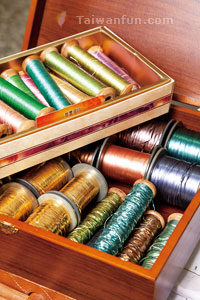  
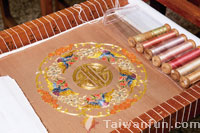
Left: Embroidery threads can be made
from gold, silver, cotton, cashmere,
wool and other various materials,
all with very different colors and
textures.
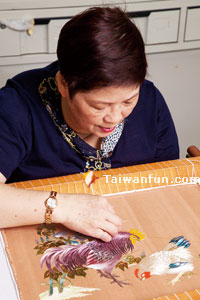
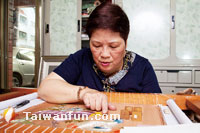
Medium: Liu Qian-shao has not only deeply explored
embroidery, but also developed specific
perspectives on this art, from sketching to
colors.
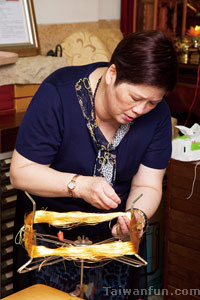
Right: Each bundle of thread must be re-embroidered
to create a consistent, smooth color surface.
Delicate embroidery marks life's highpoints
Embroidery has at least 2-3,000 years of history in the Chinese world and has been closely tied to people's lives. It was originally developed and used by fabric and clothing makers for garment decorations, using a variety of patterns, colors and materials, varying by place, time and people. This includes, for example, Suzhou's Su embroidery, Hunan's Xiang embroidery and Sichuan's Shu embroidery, all well-known in China. However, due to the difficult living conditions in Taiwan's earlier years, time-consuming embroidery was mostly used for costumes, clothing for the gods, dowry jewelry, children's clothes and other special occasions or festivals. Surprisingly, Liu is a master, not of Chinese embroidery, but of East Asian kimonos.
As we know, the Japanese kimono is the most ceremonial, formal type of traditional female dress, with attention to not only details in the material, patterns, style and design, but also the professional kimono teacher whose job is to assist others in wearing this Japanese garment, showing its importance. The belt is an important element of the kimono and has a special role. Different kimonos come with different belts and the way this is tied has its own symbolic meaning, highlighting both the kimono's beauty and the owner's taste and refinement. Therefore, the belt is usually more expensive than the overall cost of the kimono itself and its workmanship, color or material selection come under close scrutiny and consideration. Towards this goal, Liu's works involve pattern design, material selection, pattern preparation and material development, as well as big responsibility for choosing the embroidery style.
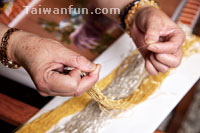  
Left: Embroidery thread isn't just made from fiber and even metal can be
used.
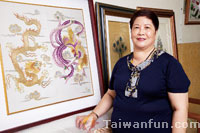
Medium: Liu has been classified as Taiwan's first Preservation Embroidery Professional by the
Bureau of Cultural Heritage, thanks to her embroidery work.
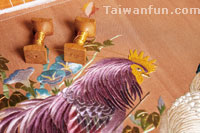
Right: Liu teaches students, using a plate gold technique to
outline a cockscomb in the end.
Colorful embroidery offers variety
Liu pulls up a wooden cabinet and, surprisingly, it's filled with neatly-arranged rolls and rolls of threads, from light to dark colors, from warm to cool colors. There appears to be about 30 variations for the shade of green alone. "There are not just these. There are lots more!" says Liu as she goes to a nearby cabinet and opens it. Here, a lot more thread material lies neatly piled, with dazzling, hard-to-choose-from choices exceeding that of handicraft-material stores.
Left: Liu has been classified as Taiwan's first Preservation Embroidery Professional by the
Bureau of Cultural Heritage, thanks to her embroidery work.
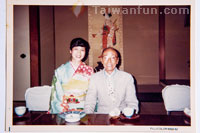
Right: Thanks to her skills, Liu often represented her company in Japan
during technical and commercial exchanges in her younger years.
If an artist uses red, yellow and blue as primary colors to magically create all the hues of nature, Liu's color work is definitely more difficult. Any color match for embroidery thread relies on re-twisting to be created, whether it is a single thread with multi-thread, multi-thread with multi-thread, or one material with single thread or one material with multi-thread, or even starting out with a whole piece of wool. Liu has learned how to match and restructure all of these.
Threads also come in so many materials, including silk, wool, cotton and gold. Even a triangle spring, sequins, ribbons and similar items all can become embroidery material options for creating more dramatic changes and more three-dimensional, realistic effects. Incorporating all kinds of embroidery, such as gold embroidery, seed embroidery, Yamagata embroidery, needle grab and pine needles, makes it undoubtedly more interesting than people imagine and all this must be combined with technique, aesthetic intuition and color-matching skills, just like any artistic practice.
 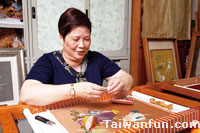
Left: Under Liu's guidance,even a complete beginner can create a very
professional and exquisite work of embroidery.
More than just needlework
Liu picks up a gold thread, lightly pulls with both thumbs and forefingers, and the circular thread immediately turns into spring-like curl. "See how smart the Japanese are? How can they find stuff like this to use as thread?" she notes in admiration of her Japanese customers and their search for excellence. To achieve ultimate beauty, they have sought out different ribbons, metal materials and threads from around the world and asked Liu to find new ways for handling them to create different styles of belt embroidery. "Kyoto likes conflicting and lively color matching, while a Tokyo favorite is elegant colors with light-to-dark variations," she explains.
After working with Japanese customers for many years, she knows the differing tastes of various regions in Japan and has gradually developed her own design sense during this process. When Liu left her company due to child-raising responsibilities and a business recession, she found she still loved her embroidering profession. Therefore, when the Taichung Holotun Cultural Center and Weaving Craft Museum invited her to lecture and serve as a teacher, her former boss didn't raise any objections to the sharing of professional business secrets and instead gave a personal blessing to Liu, in the hopes that others will be able to witness her talent. Liu's embroidery is not just "needlework" or a "custom craft", but a delicate, professional form of art requiring great skill.
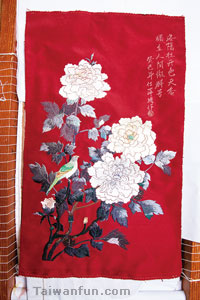 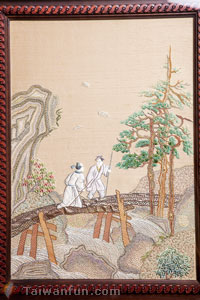
Left: Under Liu's guidance, even student work
can appear professional and delicate.
Right:
Using various colors and embroidery styles conveys the
charm of the Chinese classical style.
Transmitting delicate beauty, stitch by stitch
In the past, Liu was instructed by a Japanese master in each step, from drawing, sketching and fabric selection, to attaching the embroidery box, color matching, thread twisting, and embroidery itself. Now it's her turn to help embroidery class students design a picture, choose the thread, color match, twist the thread, and finish their works. Even knowing that embroidery would be difficult to revive in this industrialized, electronic era, Liu bought all the thread material left at her going-out-of-business company without any hesitation. When questioned, after 40 years of embroidery work, about any difficulties, regrets or problems with her eyes, Liu laughs and says, "The reporters are always waiting to see a joke, in the event that I cannot thread a needle, but it looks like I haven't made any mistakes!" Squinting, she moves her right hand up and left hand down without pause. For someone who has made embroidery a lifetime career, this isn't hard and neither is teaching embroidery. Rather, the most difficult part is seeing those threads in a way that others don't understand and putting their beauty to good use.
|

 May 2014

