Master Huang Lan-ye and the creme de la
creme of embroidery crafts: K'o-ssu Chinese silk tapestries
Words by Ye Jia-hui
Translated by Angela Cheng
Photography by You Jia-huan
"Please wait for a moment! I just need to wrap this roll of thread," says Huang Lan-ye as
she uses her right hand to pull a silk thread, holding another end in her mouth. Standing
at one side of the room but scrolling the silk thread over and over, step by step, toward the
far side, near the front door, Huang's movements resemble the tempo of her life's work,
which started by accident but has through personal perseverance taken her on a
blossoming journey into the world of embroidery.
"Lan-ye can do this! It's a good idea to let her take over the company." This was a real-life scene, although it resembled an interesting TV drama. At the age of 19, the future "Master of K'o-ssu" Huang Lan-ye went to work at Taichung's Datun Company, which was cooperating with Japanese kimono embroidery and weaving businesses. At that time, her reason for taking this job was simple: "The company had an air conditioner!"
Air conditioning! A young person's career goal
In early 1960s, kimono manufacturers from Kyoto, Japan came to Taiwan to search for subcontractors willing to take over the processes of dying, weaving and embroidering. These combined processes inadvertently led to the development of Taichung's textile industry. Although Huang didn't consider herself a delicate type of woman, having been a member of her high school track and field team when she graduated, she liked the company's working environment so she decided to give it a try, honestly informing her supervisor that she wouldn't mind signing a contract later.
Huang set a "trial period" for herself to observe the company's attitude. Thanks to her perseverance and competitive personality, she continuously kept her eyes and ears open, watching and learning during this period. Thus, she gradually acquired knowledge about all kinds of things in the dyeing, weaving and embroidery sections, working to quickly adapt while simultaneously searching for a position most suited to her personality. Her strong craving for knowledge, down-to-earth personality and willingness to move forward one step at a time helped Huang stand out from her peers and revealed a lot of potential. Moreover, her very competitive streak meant that her first weaving works were able to be sold as finished products, creating a big stir. Thus, the "new girl" who originally thought she wouldn't make it past one month on the job, not only received a promotion but became a technical instructor in her second year. Later, at the age of 25, she also became the deputy director--the highest position for a woman at that time.
  
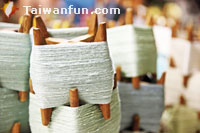
Left: There are many procedures for moving silk
thread through the frame to ensure it is neat.
Medium: Passing through the weft is a feature of
K'o-ssu and its colors can be freely
changed, enhancing the flexibility of
creation.
Right: The fabric and thread for kimono belts
uses quality silk.
Seven days! A lowly supervisor gets promoted to big boss
Huang became a core member of her company after a few years, not only doing administrative work and technical jobs with ease, but also having the capability to be both "the president" and "ring the bell", a basic ability she gained because she wasn't afraid of continuous learning but, rather, only fearful of not learning enough.
Opening a roll of silk thread, Huang rotates it up and down in an experienced gesture, as the silk seems to magically appear in a gradual sequence. "There are so many small details in this job and every step requires a special attention to detail. For example, the dyeing has its selection and collection and there's the combination and measurement for the mordant, features of fabric color, and so on, besides the basic knowledge for each step," says Huang. "Experience! Experience is most important!" She notes that because she began early and doesn't like half-understanding things, she involved herself and studied in each step in the the process of giving birth to a kimono--from the silk to dyeing, organizing the threads, twisting, spinning, weaving, embroidery, tailoring and other procedures--unlike most people, who just focus on their own responsibilities. This means that one in charge of dyeing couldn't weave and those who weaved didn't know how to tailor. People working in this way on a manufacturing line are like machinery, needing to rely on talented staff members like Huang to serve as communication bridges, enabling company employees to create fine finished products together.
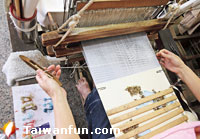
Left: When operated, the wooden loom sounds like something from "The Ballad of Mulan", making a "Ji ji fu ji ji" sound.
Medium: The creation of K'o-ssu requires excellent skills and
artistic talent, so it is regarded as an art form and joins
collections.
Right: Huang handles most of the works personally, from
organizing and rolling the thread to other preparation
tasks.
The company superiors had already discovered Huang's talents and abilities so, when the industry's environment went downhill, Japanese representatives gave her a proposal, "We'll let you take over the company and give you seven days to consider." Huang was hesitant to move from being a small company supervisor, and a mother watching over a family at home, to running the entire company. However, she then thought about the silk thread that accompanied her all the time, the employees' a place for their costs for recovery, and finding this embroidery industry in society. These reasons and her commitment made her decide to stick with the company and its employees and begin her career as a female boss.
  
Left: Huang still collects all the design drafts
for every work.
Medium: There's one color of weft in the shuttle;
if there are various colors, the number
of shuttles is increased.
Right: During K'o-ssu work, the thread needs to
be put on a wooden loom and a ship
shape shuttle is used to carry the weft
individually according to sketches.
An all-around, one-person design center
The embroidery industry is unavoidably classified as a niche market in a fast, efficient modern-day society, but this has also given quality embroidery works more economic value. "Our company's cheapest kimono starts from NT$300,000!" says Huang with a smile. She knows that even dreams should be rooted in reality, and she does not think about her work is a high-minded fine arts sort of way, believing that both art and design should be flexible and balanced between showing great skills and creativity. Without all these elements, the works will lose their balance. Thus, Huang will begin planning carefully, even when the client gives her a simple sketch. Her process includes the silk-dyeing process, use of patterns, new and creative weaving methods, considering ways to use embroidery, transforming the sketches into weaving sketches, and affixing the threads and colors to the side of the embroidery sketch. She is the design center and others in the company make up the team that helps her transform thoughts into reality. The end result is customer satisfaction, with even the Japanese admiring Huang's methods. Beyond her practical dreams and motivations, she has also discovered an enduring way to preserve an era of traditional handicrafts.
Left: 工This studio is Huang Lan-ye's creative bastion for the achievements arising from her persistence and career and passion in K'o-ssu handicrafts.
Medium: Huang's K'o-ssu works are full of modern inspirations and unlimited creativity.
Right: uang says silk needs to be treated as "touching one's hair" to understand
its and make it easier to organize.
Solid foundations create small joys
"My personality is straightforward and I prefer being practical over dreaming, and work over talk," comments Huang, who has just arranged a design from documents accumulated over almost 40 years. She knows each one so clearly--which client placed an order and when--that she references them faster than a computer could. It is her philosophy that the smaller things need to be finished immediately, just like she manages embroidery thread, silk thread, flower prints, dyes and other items. If you cannot manage your time well, it's like making trouble for yourself, so manage your time wisely to conserve your strength, she notes. "People like to talk about 'soft power' but they must understand the profound importance of having a "hard base" of skills that will qualify them to talk about the 'soft power' of the mind!"
Even though Huang is known as the "K'o-ssu master" and has won numerous weaving awards, the National Crafts Awards and other forms of recognition, she is very low-key about these achievements. For her, the fine K'o-ssu embroidery skills are a truly delicate and precious weaving method that not only feature abundant pattern changes, but also are able to create a three-dimensional effect with high artistic quality, leading to its moniker as "the saint of weaving". However, without an earlier generation's accumulated knowledge and heritage, future generations would be lacking the foundation of solid cultural wisdom and personal creative value. In light of today's fast-paced, modern society, Huang was asked whether she worries about failing to find anyone to inherit this craft. She smiled and answered, "This is something I cannot, and would not, insist upon. If there is someone, there is. If not, then there's not. Time will tell us the answer."
Huang Lan-ye
TEL: (04) 2389-0793 |

 August 2014
