


|
Journey back in time at the
Taiwan Folklore Museum and Park
Words by Ian Crews Translated by Angela Cheng
The content is developed jointly by Industrial Development & Investment Promotion Committee of Taichung City,
FM 89.1 Sunny Radio and Compass Magazine.
Taiwan Folklore Park and Museum is "more than one, but less than seven, stones' throw away" from the major intersection of ChongDe and WenXin roads. If you're travelling north on Chongde Road toward the Intercontinential Baseball Stadium, it will be on the right, directly behind the Zhong Ke Hotel (中科大飯店).
The park is a nice, open space in a fairly densely-populated part of Taichung. The park alone is nothing extraordinary, but is a well-manicured space all the same, refreshing to see amidst all of the concrete. There is a small playground for kids to run around and be kids, as well as a small amphitheater where, at night, older generations of Taiwanese women convene for their ritual dance-exercise (dancercising). Otherwise, it is simply a park.
The real draw of the Taiwan Folklore Park and Museum is, of course, the museum. The museum was first proposed in 1981, with construction starting in 1984 and finishing in 1990, when it was opened for public visitation. The original plan included a space for both a park and museum, which remain neighbors today. Everything about the museum and its surrounding buildings screams "traditional", from the architecture to the landscaping and displays. There are a multitude of excellent examples of traditional Taiwanese structures scattered around the island, some arguably better than those at the Folklore Museum, but they are not in the middle of Taiwan's third-largest city and they do not serve as a repository for a huge amount of Taiwan history.
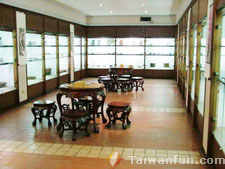
In keeping with its name, the museum displays do not portray the high points of Taiwan's history, nor great works of art or technology or culture but, rather, everyday items, such as toys, household goods, tools and furniture. This is a space for a collection and exhibition of Taiwan's recent past. There are even some dioramas of traditional workers and shops so that visitors can get a glimpse into not only the traditional Taiwanese family, but also work and commerce from earlier times. For those visitors unable to read Chinese, bilingual descriptions are unfortunately few and far between. However, the recreated settings—a living room, shops, kitchen, bedroom—as well as the things—the aforementioned toys, utensils, etc.—stand on their own. This is not the National Palace Museum, so there isn't a pressing need to read about the historical relevance or a particular period of history for a given display or item. It is enough to slowly walk through, browse, and just enjoy. Being able to read Chinese--or having a companion who can--will of course add to the experience, but it isn't required.
Traipsing around the museum's grounds is also highly recommended. The surrounding buildings are just as exemplary of Taiwan's history as the museum is. The Chinese-style garden adjacent to the museum is particularly worth a look..and a taste. There is a small restaurant next to the entrance, and the well-prepared food features--you guessed it--traditional dishes. Sitting at one of the many tables surrounding the garden's central pond and munching on rice dumplings or sipping some corn soup really does feel like you are a part of history, having gone back in time a hundred-odd years. It's a rare treat for the culturally and historically minded. The trees aid in this mental rewind by blocking out the high-rises that are directly across the street. The only touch of modernity to be seen is the pond's splashing water (thanks to some mechanical wizardry and not fish) and the only touch of modernity to be heard is (of course) traditional music being played on a speaker system.
Given all this and it's modest size, a jaunt through and around the Folklore Museum and Park is a perfect morning or afternoon outing.
73, LuShun Rd, Sec. 2, Beitun Dist
(04) 2245-1310
Hours: 9 am-5 pm (closed Mon.)
Tickets: NT$50-80
|

 September 2014

