The amazing world of paper
folding: 3D paper folding master Lai Zhen-xiang
Words by Ye Jia-hui
Translated by Angela Cheng
Photography by You Jia-huan
"Paper folding is an application of mathematical roots and principles, such as the variation from the square root of two
or square root of 3," says Lai Zhen-xiang. While observers may at first think that artistic creation is a random, abstract
process, 3D paper folding teacher Lai notes that order, structure and an infinite imagination can be combined to create a
more magnificent work of art.
How many variations can be found in a piece of paper? "Just four folding angles could entertain you for at least a hundred years!" confidently declares Lai Zhen-xiang as he uses his strong, sure fingers to fold the diagonal.
A paper crane and infinite imagination
Twelve-year-old Lai Zhen-xiang was on his way home from school as usual one day when he came across a paper crane left by someone. Out of curiosity, he unfolded the paper and then refolded and unfolded it again and again along its creases. He continued pondering and exploring this paper creation all the way home. Today, after 58 years of refinement, his eternally fresh, curious and pure heart has remained light, allowing that little boy to become today's 3D paper folding master, famous around the world to the point that foreigners seek out and like his Facebook page.
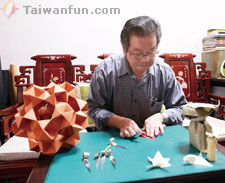 
Left: Lai Zhen-xiang has researched 3D paper folding for 58 years.
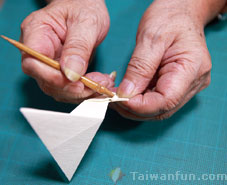
Right: A discarded pair of chopsticks can also be an ideal paper folding tool.
"I studied business, and am also the only child in my family, so my father gave me responsibilities at the family business very early on, from ordering and delivery to billing. Doing all this stuff and taking responsibility for running a business at young age brought a lot of pressure," says Lai, holding crepe paper in his hand as he recounts the story of his youth. In order to escape the stress of work, Lai began the life of a "night owl", working hard by day and spending quiet evening times. He would spread out a sheet of plain paper, which immediately allowed him to enter the ever-changing world of paper folding, as two lines and three points stimulated a seemingly boundless imagination.
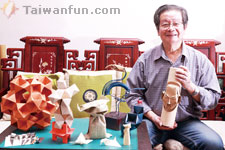 
Left: Whether using simple or complex materials, teacher Lai always has a way of
creating fresh artworks.
Right: Paper folding tools are mostly customized by Lai himself.
Artistic talent integrated with sense and sensibility
From a young age, Lai not only excelled at math but also did very well in art such as calligraphy and watercolor and oil painting, making him a frequent winner at major art competitions. With his combination of aesthetic sensibility and mathematical sense, paper folding eventually became his ultimate artistic pursuit. He loves to create this art with basic colors in order to generate strong visual contrasts. Another reason is to create the same visual effect as plaster, wood carving, cowhide, ivory carving and so on, though folding paper cannot be created "randomly". Rather, its points, lines and forms must have a coherent relationship. In order to understand this structure, the creator must continuously practice. Discovering the seemingly complex rules of logic and their variations and then venturing off into the unlimited variable world to create folding paper art sometimes relies on past experience, and sometimes arises from unexpected surprise discoveries. This is what makes the art of paper folding so charming and fun.
 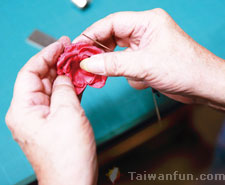
Right: Although a folded line is straight, it can rely on volume
and pinching to illustrate curves and the radian.
Skillful movements: The challenges of pinching and pulling
Lai says that because each fold is a straight line, the ability to show a vivid facial expression, filled with life and vitality, relies on a creator's experience and skill, honed with a lengthy period of exploration and experimentation. Among the the 32 paper-folding skills--such as buckling, twisting, drawing, clutching, pulling and pressing--he considers the "pinch" to be most difficult because each pinch requires a different amount of force to illustrate different lines, including emotions and expressions. If the same spot is pinched more than twice, it will change the paper's texture and have an irreversible result. Thus, if it turns out badly, everything goes down the drain and one needs to start all over again. The "pull" skills must also be very carefully applied; sometimes a semi-finished product takes several hours to make and if you accidentally pull the wrong way you have to start all over again. Whether the work is perfect or not has a great relationship with the thickness of the paper and its ductility--being too thin or too thick will affect its beauty--so folding paper trains not just your patience, care and concentration, but is also a great, extremely imaginative challenge.
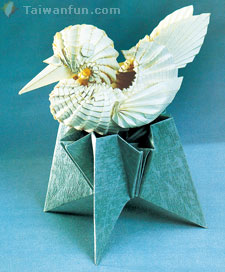 
Left: The principles and variations of folding paper have
mathematical roots.
Right: Lai's favorite paper folding theme is Oriental zen.
Lai Zhen-xiang never gets bored in his paper folding world since it's his favorite and most fun pastime. The paper's vertical and horizontal orientation and its thickness seem like small details but a lack of care can lead to fatal harm in one step and make everything wrong. During the creation process, Lai presses a line with his nail and fingertip. In fact, he has a much more bizarre weapon which can be fixed to a finger joint to assist with pressing, while others serve like a roller. "Look! It's just like the movie 'Edward Scissorhands'," says Lai with his impish smile, unable to resist moving his finger set up and down. "World-class architect I.M. Pei said 'You have to create your own tools if they don't sell them in the market!' and this impressed me a lot."
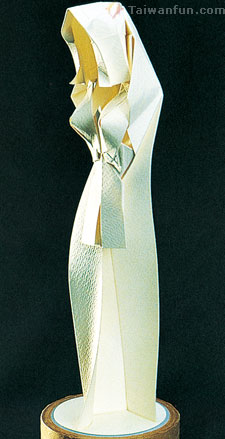 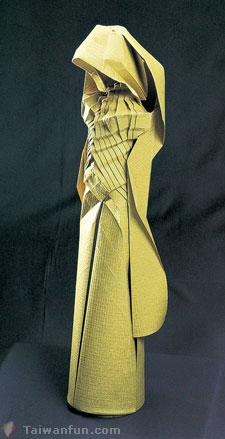
Left: Folding paper relies on
consummate skills needed to
bring plain paper to life.
Right: Combining complex and simple
structural lines can make artwork
more meaningful.
Since paper folding is not considered important in the art field, there are fewer people who share these skills and their research. When Lai has had questions, he has only been able to ask himself. However, perhaps due to deep thinking and the experimental process, his works are filled with originality, and there are numerous examples of his self-developed tools; whether it's a glass frame, his wife's discarded chopsticks or an extra metal plate from friends, all can become unique paper folding tools for Lai. During his process of making art, Lai not only creates artworks but also tools. When he was hired by a school, students initially were completely unfamiliar with paper folding but then Lai took out his stunning styling tool, amazing students and making them curious to the point that they began to admire the art of paper folding.
Experiencing the beauty of 'purity'
Lai Zhen-xiang's work style is unlimited, containing modern, classical, realistic and even sci-fi elements. However, works always convey philosophy, science, Buddhism, physics and deep thoughts from other fields. Lai smiles and says that whether you have great or small knowledge, everything can be obtained through learning, although with a sigh he is often confused when facing today's young students. Regardless of whether he is instructing at a university, high school or junior high school, Lai always longs to share all his knowledge and skills with talented students. But perhaps there are too many temptations in the sounds and lights of a modern environment. Also, educational policies cause young people to seek knowledge for profit and few people are willing to work hard just on one simple thing, purely and patiently. Great oaks are grown from little acorns, just like the art of folding paper. Even the greatest work relies on the simplest foundation of points, lines and forms. Modern people have abundant mediums for enjoyment and indulging the senses, so it's no wonder that they are not able to appreciate pure beauty. Lai recalls his youth, when he would stay up late creating in contentment and joy--a simple pleasure that in fact has generated a wealth of life experiences.
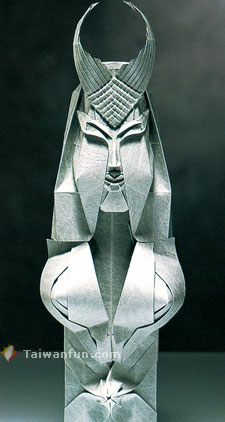 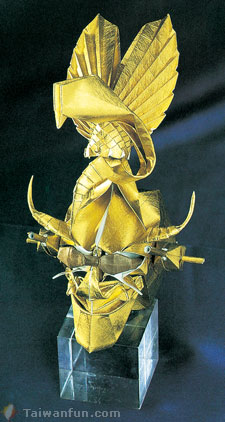
Left: Besides excellent skills, paper
folding must be free to hurdle
real images and subconscious
boundaries.
Right: Paper folding art can illustrate
various themes; even science-fiction
can be integrated as a main subject.
Lai Zhen-xiang
Address:
272, ChengGong Rd, Central District, Taichung
Tel: (04) 2222-2448
|

 December 2014

