National Library of Public Information:
Streamlined architecture that challenges
the conventional
Words and photos by Lin Po-yang
Translated by Alicia Yu
Large works of architecture have the ability to transform the urban landscape, serve as fresh focal points of fascination, and become new landmarks
for marketing a city. Tunghai University's Luce Chapel, designed by renowned American architect I. M. Pei, broadened Taichung's architectural horizons
in the early days.
Following completion of the Asia Museum of Modern Art (by Japanese architect Tadao Ando) and National Taichung Theater (designed by another famous
Japanese architect, Toyo Ito) in the past two years, Taichung's urban landscape has continued to internationalize.
Open access to these public developments not only stimulates much discussion and attracts media attention, but also undoubtedly has an on-going and
future impact on residents' leisure activities and aesthetic experiences.
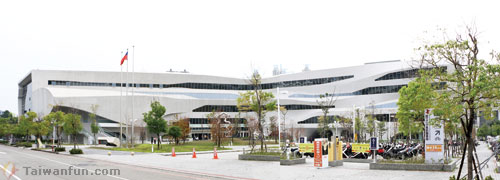
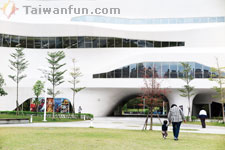
Completed and opened in 2012, the National Library of Public Information (NLPI) followed Taichung City landscape redevelopment trends and made headlines in central Taiwan. Besides its eye-catching appearance and goal of replacing library space design conventions and creating an aesthetic symbol of the digital flow of knowledge, this structure is noteworthy by not being the work of any international architect. In fact, its design and construction supervision, planned by architectural firm J.J. Pan and Partners, were executed by a Taiwanese team throughout its construction. In addition, its architectural design ideals and construction challenges are worthy of study.
'Flowing' reading space
What kind of design proposition are its streamlined, pioneering contours derived from?
With the arrival of the digital era, paper books are being replaced by e-books. Thus, the modern library needs to convert its essential and conventional function of housing book collections to a more attractive and social one. In other words, libraries are no longer static and out of reach, but now realized in a recreational, happiness-sharing way, like a "family living hall", to encourage visitors from different classes and cultural backgrounds to exchange and share their ideas.
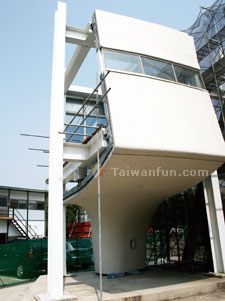 
Left: A pilot model on a 1/1 scale for
construction execution.
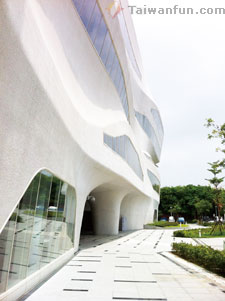
Right: The entrance and exterior wall embrace a "breaking
the boundary between floors" design.
The feeling of "flow" plays a vital role when it comes to overturning static, longstanding impressions and designing a building that is completely new inside and outside, and for which both design propositions and real spaces have never been realized before. The outline of such a building cannot be realized just by drawing flowing lines with a certain speed on a piece of paper. Architecture is a three-dimensional creation, the external form of which is the outermost interface with solid constitution and dominates its relationship with the surroundings. As a result, out of nature the external form has a mutually beneficial relationship with the building's location, function and development direction on the land.
Surrounded by major roads such as WuQuan South and JianCheng roads, the library's foundations are confronted with an intersection filled with cars and pedestrians. To allow natural light inside, the L-shaped building is intentionally constructed along the southwest corner of the site. The architectural planning is used to block noise with the central site area spared for green space, allowing library visitors who enter the plaza to escape outside noise and be embraced in a relaxing environment, much like coming home.
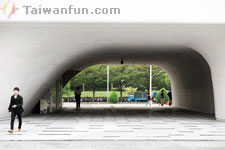 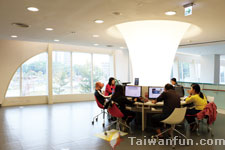
Left: The entrance to the "tunnel of knowledge".
Right: A flowing reading room interior.
The central plaza is a metropolitan stage and a family "living hall" where a variety of activities take place. The reading area near the windows is like an auditorium, where one can enjoy the fresh greenery outside while reading a book, as well as pay attention to what's going on in the living hall. In addition, the curving design blurs the boundary between the interior and exterior and is so visually connected that the interior and exterior seem to become one. Like the entrance of a tunnel, the first-floor gateway on WuQuan South Road is intended to cut inside the L-shaped design, attracting people to walk along its wandering exterior and bringing them out in the living hall of the building.
But how should this streamlined look be designed? Practically speaking, a required fundamental element for the exterior are "windows", which help form visual perceptions for those inside and outside the building and are an important mechanism for people to see each other. How should such windows combine with the streamlined look of the architecture?
The ingenuity in this regard lies in the idea of "breaking the boundary between floors". Though the band-like windows seem randomly distributed in parallel on the exterior and give no clues of an exact boundary between floors, they naturally extend the building's horizontal lines and in turn create the sense of flow. When an inside person looks outside, the fact that the windows are not conventional rectangular frames like viewfinders, but rather a surface composed of a series of irregular shapes, means that the viewer will observe different landscapes according to the angle of view at different horizontal planes, so that vision can be extended and broadened.
The notion of "breaking the boundary between floors" abandons the concept of vertical and horizontal lines on a rectangular box which architecture usually has, and instead creates an appearance defined by natural flowing lines; that is, it abandons "correct thinking" about architecture from a unitary perspective and puts into perspective every element that constitutes the architectural surface and the relationship between the elements.
Put in a simpler way, the idea is to see the building as a diamond, which radiates from every angle, without any "correct" perspective. The elements that constitute its external appearance are like the cut surfaces of a diamond which influence each other and reflect light from the surroundings. A marvelous work of this sort can only be realized by cutting from precise angles and generating proper surfaces to reflect the environment.
Challenges engineering of 3D curves
In the usual, romantic imagination, words like "construction" and "engineering" sound stiff and are difficult to connect to the impressions offered by a designer's unrestrained and vigorous creativity. Nevertheless, in the fields of practical design such as product design, industrial design and architecture, whether a concept can be realized, an idea can be merchandised, or a space can present an effect in reality as hoped for, all have a deep inseparable relationship with construction and engineering. More precisely, the lower-stream operational stage, including construction and engineering, requires an even more precise "design".
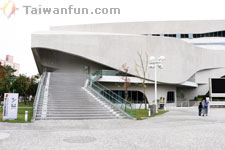 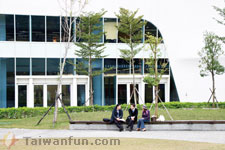
Left: A grand staircase for the urban stage.
Right: The city's "living hall".
According to the conventional construction concepts of architecture, the execution of the lower-stream design is to break down a 3D architecture into different figures like plans, elevations and sections to examine the possibility of construction. To elaborate, only through a working drawing based on these figures to solve every connection in the details of structures of solid space and a plan over the order of different types of work can the budget and construction period be efficiently managed.
For a streamlined space like the NLPI, the difficulty lies in how to realize the curves the design team finalized after countless discussions. During the discussion stage for aesthetics, the design team exercised mature 3D graphic design software developed in recent years to simulate all kinds of colors, materials and shapes, and spared no efforts to consider the possibilities for all kinds of external forms. In a similar vein, the 3D graphic design software played a crucial role in the construction period. Through the positioning and calculating function of the software, the designers gained access to the data about the structure's external form from different angles. In addition, the properties, connections, quantities and positions of materials were examined according to this data before the working drawings were produced for subsequent use by subcontractors, all enhancing the fluency of the building process.
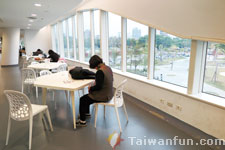 
Left: The reading area near the window is just like an auditorium,
enabling indoor reading atmosphere and outdoor activities to
interact with each other.
Right: Pattern-embedded lines.
It can be said that architectural design is more than a process of drawing beautiful lines and is a battle between the pulling and pushing forces of perceptual association and rational planning. The "traces of struggles" behind the architecture may not be seen by its users and ordinary people, but its "inner" structure is a result of cautious and rigorous analyses in which an aesthetic order is embedded.
Though the NLPI gives people an eye-catching and unforgettable visual experience, we should not forget that good architecture that is beautiful inside and outside requires not only moderate perceptual stimulation from design but also the construction team's rational analyses and management over construction procedures, building materials and engineering methods. It is via all such components that the seemingly random lines can be realized reasonably and precisely. Besides, the completion of an architectural work cannot be accomplished solely via an individual architect's design, but relies on the persistent communication and collaboration of the whole team from the upper-stream to the lower-end, which bring about a tranquil but flowing space where readers, content and enjoying the fragrance of books, can experience the visual and soulful palpitation that "dynamic" architecture brings.
National Library of Public Information
100, WuQuan Rd, South District, Taichung
Opened June 3, 2012
Designer: J.J. Pan and Partners
Features: The library's green plaza is reserved as a city "living hall". The appearance of the library uses lines to illustrate the "skin" of the architecture and represents the urban "flow of knowledge".
Writer's profile

Lin Po-yang was born in Yilan. He studied architecture in Taichung as an undergraduate and worked as a professional architect for years before be began lecturing on architecture in the same city. He is a passionate architect and designer who explores every possibility with relentless effort. Paying special attention to the public-ownership nature of architecture and arguing against individual ownership over it, he hopes to create good public spaces and elevate the quality of residents' real living and aesthetics.
Lin was nominated for the ADA Awards for Emerging Architect in 2014, and is now in charge of Fieldevo Design. He's also a part-time lecturer at the National Taiwan University of Science and Technology's Department of Architecture.
|

 February 2015
