A concrete psalm of praise
and worship: Taiwan Presbyterian
Chung-Shiao-Road Church
Words by Xie Wen Tai Translated by Anna Yang
Photos by ARIA Architect & Planners and AMBi Studio
For many years, Taichung's JianCheng Road has served as a major access road, where a stream of vehicles rushed by a historic building standing alone on a corner. Now, in a sudden, striking contrast, at Taiwan Presbyterian Chung-Shiao-Road Church's recently-remodeled and expanded church complex, a visually-striking structure here is grabbing attention with its unique design.
This decades-old church was established in 1957 and its old chapel, completed in 1962, became a well-known landmark on ZhongXiao Road. However, due to large, capacity congregations during its services, the church made plans to expand, creating a rectangular complex with newly acquired property and buildings facing JianCheng Road and DaGong Street. Integrated planning for this development site was overseen by Wei Li Liao Architects Office in 2011.
The new church faces the 30-meter-wide JianCheng Road and is designed to serve the community's spiritual and education needs with contemporary approaches. At the same time, the old church building has been redecorated and transformed into a welcome center for events. In order to welcome more participants, administrative offices, the pastor's office, a recreational area, and rooms for mission and educational purposes were also added to the church.
 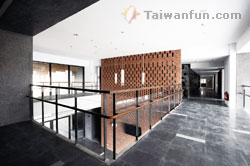
Right: The long brick wall in the lobby extends through the upper atrium space so that the
view from the lobby is expanded to the classroom and meeting rooms on the
second-floor hallway.
Responding to the call to be humble and faithful
The church is mostly surrounding by machinery companies, with most South district buildings being older and not ideal for new housing developments. However, the architect found this a unique site cultivate a "new sprout from the soil" and applied the construction materials of red brick, steel, iron sheeting, concrete and glass to echo the nearby older buildings and factories.
The spacious first-floor pedestrian walkway is safe and user-friendly, while the roof of the walkway is supported by a sole heavy steel column with the worship hall positioned directly above it. This creates a breathtaking appearance that reflects the church's gospel message.
The four-floor brick wall facing DaGong Street was designed to correspond with neighboring brick houses. Every other brick on the wall is pushed out, giving the wall an even more distinctive appearance and, at sunset, the pattern of shadows generated by the prominent bricks seems to create an image of pouring rain, expressing the idea of God's power over nature.
As the building is viewed from JianCheng Road, its two-floor steel-framed glass walls are also visible, delighting passers-by with the combination of brick and modern glass. I believe this magnificent work is made by humans but given by God.
A center view of the church reveals a cantilevered third floor. Behind the main cross, there is an educational training space separated by glass and surrounded by hallways, giving it the external appearance of a lantern and also making it a base to support the worship hall.
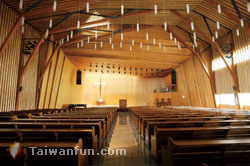
The worship hall is the most remarkable space in the church, with walls and ceilings
featuring interrelated steel and wood in repeated hexagon shapes.
An 'ark' of worship
The worship hall on the fourth and fifth floors is the main gathering place as well as the church's most uniquely designed space. Its irregular shape resembles an ark, being covered with tarnished layers of blue-greenish copper plate. The colorful markings on the copper, matching the local historic environment, is my first impression of the church and have been generated by exposure to sunshine, air and water. This represents not only the passage of time, but also the courage granted by a faith in God despite any trials and other "waves" in life.
When turning onto DaGong Street behind the church, a square created out of a two-story-high wooden and steel frame will catch your eye. The walls and staircases of this square are made of exposed grey concrete, giving this semi-outdoor space a peaceful, humanistic aura. The back side of the church square contrasts the architecture across the street to create interesting comparisons.
In fact, the utilized steel, glass, brick or steel, and iron plates are all common building materials in the nearby neighborhood. However, the architect put such commonly-used materials towards a completely new spiritual purpose with his own design and arrangement. On the long and dusty JianCheng Road, the church resembles a bluish-green Turkish jade mosaic on a dark silver chain. Its appearance is modest but eye-catching, demonstrating the architect's humble, but confident, attitude toward the surrounding environment.
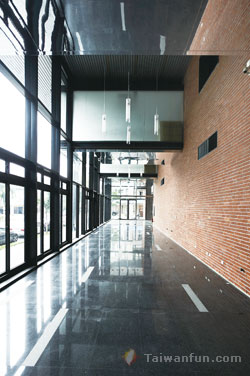
The glass wall on the lobby floor is a visual
connection between the people inside and
walkers on the pedestrian pathway.
A spiritual sanctuary transforming the temporal into spiritual
The new worship hall is designed to serve a multifaceted community and variety of purposes besides worship. Thus, there is a hidden order with earthly things on a lower level and spiritual ones on the top in the arrangement of floor spaces.
As one enters the lobby from JianCheng Road, a recreational area in the corner can be seen. This space is provided for social events and exhibitions, and can also be used for smaller church gatherings. Passers-by on the street can be connected visually with people inside through the glass walls, reinforcing an energetic, welcoming feeling.
A long brick wall in the lobby extends through the upper atrium area, expanding the sight lines to the classroom and meeting rooms along the second-floor hallway. Second-floor classrooms facing the road are designed in three rectangular shapes that stretch out over the other end above the first-floor recreation area and pedestrian pathway. This represents the ambition of intellectual curiosity and a reconciliation with spiritual pursuits that these spaces serve.
The church's floor chart resembles a pyramid, with the ground floor an open social space for visitors, the second floor open for educational purposes, and the third floor limited to biblical/spiritual growth for church-goers. The architect focuses on ministry-related purposes in the rooms surrounded by hallways and separated by glass walls on the third floor. The unique arrangement here allows sunlight to illuminate these spaces.
Walk up along the stairs in the semi-outdoor courtyard and light and shadows change shapes as they pass through the long windows, inspiring reflection as one climbs higher. To reach the fourth-floor worship hall passage through a low-ceiling hallway is necessary. The starry lights on the ceiling are a hint of this entrance into the sanctuary, whose enormous space creates a sense of humility.
The worship hall is the most remarkable space in the church. The walls and ceilings are marked by steel and wood used in repeated hexagonal shapes to create a floating, spiraling dome. Hundreds of hanging light tubes suspended from the ceiling resemble floating white candles, forming a quiet place of purity. During the day, the triangular window shapes form a complex cross with an interplay of light and shadow, in an image that is both practical and moving. The front area towards the altar reveals, to the left of the stage, a cross illuminated by sun beams from a skylight, symbolizing God's omnipresent love.
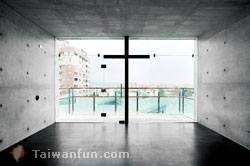
Outside the main hall and up a stairway is a tiny prayer room, located at the far top end of a rectangular-shaped classroom and above the worship hall. The purpose of this separate space is a peaceful place to be with God, with the thick concrete walls on two sides contrasting the glass walls facing the city in the front and back. Worshipers can face a cross blended into the glass wall, at the far end, looking across the city skyline. Visible through the lower end of the glass wall is the green rooftop, symbolizing the wilderness.
A touching, faith-inspiring psalm
The architect built this architecture and created many spaces as a metaphor. Observing the flowing spaces in the square behind church is another way to study this structure. As I entered from the semi-outdoor square in back and walked up the concrete stairways connecting each floor, the abundant light had a poetic flow to it. Visitors standing between stairways in the changing light and shadows feel their emotions quieted as they approach the sanctuary.
This poetry-like design which flows through the whole church does not lose its way; rather, it is logically and properly arranged everywhere. If the style follows the self-constraint of the book of Psalms, and the space is a lyrical turning point, then its "words" are a beautiful expression. In this work, the architect presents a wonderful structure that rolls in tall, powerful waves that ultimately find peaceful silence in a small prayer room
Taiwan Presbyterian Chung-Shiao-Road Church
Location: 288, ZhongXiao Road, East Dist., Taichung City
Built: June, 2015
Architect / Design: AMBi Studio
Characteristics: The mixing of common materials--bricks, steel, glass, wood, and soil--are creatively transformed into a brand-new architecture that matches local surrounding homes. The irregularly-shaped dome and rusty copper green appearance resembles an ark, making this a rarity in the city.
 Writer's profile:Xie Wen Tai Writer's profile:Xie Wen Tai
A long-time resident of Taichung, this romantic architect believes that wonderful stories will emerge from beautifully-designed spaces. Although his foolish love for the old parts of Taichung compel him to do what others view as stupid, some of his silly deeds somehow have slowly become wonderful stories, one by one.
He holds a master's degree from the Department of Architecture at National Chengchi University, and now is a lecturer there in addition to Tunghai University and Chaoyang University of Technology's Department of Landscape and Urban Design. Mr. Xie has dedicated himself to projects related to community building, school landscape improvement, revival and preservation of cultural assets in the city, and renewal of city spaces.
|

 April 2016
