Taichung's treasured Second Market
Savoring a century-old marketplace and its delicacies
Sponsored by Hao Hsi Words by Cai Jin-ding
Translated by Anna Yang
Photography by Reflection Photography
Taichung's Second Market is definitely a top dining spot for a number of epicures when visiting the city. This well-known market, also known as the "Japanese market", has become a nostalgic destination for local delicacies as well as a famous landmark for tourists. When sampling the delicious edibles found here during a visit, it's also well worth learning more about the history and heritage behind them.
What is the definition of a "traditional" market? Is it a grungy, unpopular place, or a destination rich with culture? With the development of public transportation and shopping districts, all of Taichung's nearly century-old markets have overflowed with great bargains and become nostalgic multifaceted spaces filled with meaning. Among these, the most representative is Second Market (Xinfuding), open since 1917.
Camera-toting tourists and other visitors can wander around this marketplace's brick building, which is crisscrossed by six alleyways that give it an appealing maze-like atmosphere. Eateries here sell items like meat balls, braised pork over rice, noodles, black tea, radish cakes, and Grandma's specialty noodles, and are always crowded, thanks in no small part to enthusiastic support from bloggers. However, besides the main eating attractions, there are even more treasures to be discovered here.

The Japanese Market (Second Market) was established in 1917 and sold high-end items, leading it to become a must-visit spot among locals and visitors for dining.
Dining history and culture
When one mentions Second Market, the most popular delicacy has to be Meatballs and Braised Pork over Rice. Dingshan Meatballs, opened in the 1950s, was inherited by the founder's second son while the oldest son opened another meatball shop, Maochuan Meatballs, near the market. Both businesses are now run by members of the third generation and attract a following of loyal customers.
Two other recommended market food spots, Lihai Braised Pork over Rice and Chongming Noodles with Braised Pork over Rice, became popular in the 1960s. Later, Shanhe Braised Pork over Rice also gained fame thanks to online publicity of its long lines of waiting customers. Locals also head for Yupili (fish skin shop) and Lurochiu (braised pork shop) for good traditional flavors. Taichung's braised pork stands apart from its northern Taiwan counterparts, as store owners in Taichung ask customers if they like the fat or lean pork before serving. Because some visitors do not eat Taichung-style fat braised pork over rice, and owners are nice enough to ask customers for their preference.
Although braised pork and meatballs are part of today's popular dining scene, back in the 1950's and '60s, these eateries' existence in a traditional market were expressions of the flourishing local economy of that time. During that golden era, buildings featuring ballrooms, theaters and restaurants around the traditional market were not frequented by most people due to the high prices. Thus, popular eateries in the market flourished alongside the booming pig-farming industry, and a huge chunk of braised pork and minced meat became a comfort food, not to mention an affordable energy source, for laborers.
Six decades of noodle-making history
If you are willing to squeeze through the crowds and waiting lines in the market, you will come to the simply-built, traditional Wude Temple, where merchants' most respected Guangshengdi god is enshrined. Right behind the temple is the six-decade-old "Hongren Noodles Shop: Damienai", a third-generation noodle maker and the main source of noodles for most noodle vendors in this market.
The 76-year-old owner, Mr. Tsai, recalls Second Market 60 years ago, noting, "At the end of World War II, the Japanese surrendered in 1945 and all of the Japanese merchants had to go back to Japan. Thus, Taiwanese merchants arrived to fill up these slots. My dad was one of these Taiwanese vendors at the age of only 5. He sold Taiwanese yellow noodles at first and then began making mainland Chinese-style plain noodles, known as yangchun noodles. The merchants were easy-going and friendly to each other, often drinking tea and sharing mainland-style noodle-making techniques with each other."
Although most of the customers purchased noodles directly from vendors, the third-generation noodle-making shop and its machines still run well today, producing kilograms of noodles for shipment to other vendors. Tsai noted that the ingredients are simply salt, flour and water, part of the lasting success of this business.
 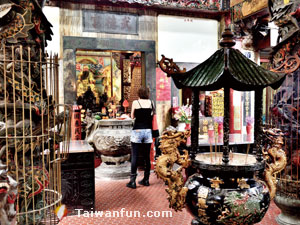
Left: The third-generation Hongren Noodles Shop provides noodles to vendors in
the market.
Right: The Guangshengdi god in the market is the most revered deity for many
merchants.
Business under the Rising Sun
During the Japanese colonial period, Taiwanese residential areas were mainly centered around today's ChengGong Road (formerly Gangcheng ciaotong), with the First Market being the main place of daily-living necessities. Second Market was located on Hsingding and Fugueiding areas and was thus known as Hsingfuding Market. This "Japanese market" connected to ZhongShan Road where many Japanese often socialized. A wide range of high-end silk shops and stores selling imported items were spread around here, and social economic divisions were clearly defined as well.
At the war's end, Second Market's environment fell into disorder and chaos, filling with illegal vendors. In 1954, then-mayor Lin Chin-piao stated, "Taichung used to be a wonderful city during the Japanese ruling period. However, with an overcrowded population and worsening economy, the city has gone bad." That same year, the Taichung City Government tore down illegal buildings on ZhongZheng Road (today's Taiwan Boulevard) and renovated 12 stores there in order to improve public sanitation and boost the local economy.
Although governments changed, living necessities and habits remained the same. After the war, some new shops began importing clothing and daily-life commodities from Japan for Taiwanese customers, leading to a new business trend of clothing retailers that has continued.

Famous delicacies in the market attract the crowds.
Today, some shops selling Japanese items remain in the market, although the number of customers has fallen. Now 81 years old, Ms. Wang has run her Japanese-products shop for 60 years, since she was in her twenties. Business isn't booming like it did in the past and many of her customers have aged like she has. Although Ms. Wang and her husband enthusiastically welcome visitors waiting in the lines by popular food vendors, not many enter the shop.
Grandma's premium dishes
Another distinct feature of Second Market are its wholesale retailers. For decades after the Japanese colonial era, crowds would purchase fruit, fish and vegetables from around central Taiwan at this wholesale market. Several vendors, including sellers of meatballs, braised pork over rice and nostalgic buffet-style dishes, opened at the time and many shops still exist today.
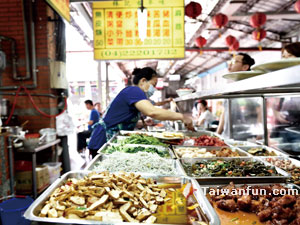
'Grandma's Premium Dish' is a nostalgic buffet restaurant and a perfect way
to enjoy good old-fashioned flavors in this market.
Later, the wholesalers gradually moved out and numerous wealthy customers relocated to western Taichung. The houses around the market were too pricey for people from other places to purchase, leading to a population drop around Central district. As the wholesalers have departed this area, the remaining shops have become popular largely via the Internet, which has highlighted attractions like the nostalgic flavors of the buffet Linchi Restaurant across from Wude Temple and "A-er" food shop.
Another eatery, Grandma's Premium Dish, offers varied seasonal, made-to-order dishes for reasonable prices; such old-style flavors can only be found in traditional markets. The restaurant offers seasonal "Mua-yin Soup" (jute soup) from central Taiwan and, when business was good, could sell 200 kilograms of this food item per day. However, a decrease in local-dining gourmands in recent years has led to a drop in Mua-yin products. Jute farms are mainly situated around the nearby Wufeng-district Wuxi Bridge, and the closure of Nantun's jute farms due to housing developments has led to a significant further decrease in products.
Modern coffee in a traditional market
Imported Japanese items during the Japanese colonial period were known as "modern items" that expressed a new way of living. Among these was siphon coffee invented in Germany and imported from Japan. After enjoying the market's delicacies, many visitors like to take photos at the intersection of the market's six alleys, designed for the purpose of public sanitation and better air quality and a place where anyone can enjoy a leisurely moment.
pproximately seven years ago, 3-1 Cafe opened on one of these alleyways, allowing customers to enjoy a peaceful moment with a cup of black coffee made with a siphon in the market. The cafe also sells curry rice, juices and fruit shaved ice. This cafe, whose name is its market door number, mainly offers Mambo Mandheling coffee made with a siphon.
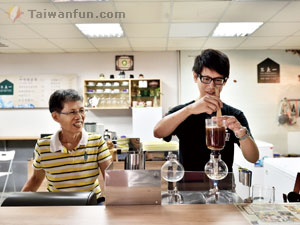
3-1 Cafe provides siphon coffee, imported to Taiwan during the Japanese
colonial era, that customers can enjoy for a peaceful interlude.
Whether it is the popular vendors whose food treats continue to attract long waiting lines, Japanese-product shops, or the trendy cafe above, all of these Second Market businesses can be considered treasures that continue to passionately welcome customers.
|

 November 2016

