|
HOME
> CENTRAL
TAIWAN > TAICHUNG > ARTICLES
>
COMPASS
MAGAZINE, MAY 1999. VOL. 6 ISSUE 5
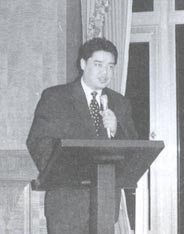 |
Wu'er Kaixi Speaks at AmCham |
Anyone who remembers the student protests at Beijing's Tiananmen
Square in 1989 and the subsequent massacre probably also recalls
a young student leader named Wu'er Kaixi. During its monthly dinner
meeting on March 30, the Taichung American Chamber of Commerce was
honored to host Wu'er as its guest speaker and hear his views on
a wide range of topics.
Wu'er, who escaped China after the massacre, has continued in his
role as Chinese democracy advocate. After living in the United States
for a period, he moved to Taichung several years ago with his wife,
a native of this city. He not only hosts a daily radio talk show
but also serves as a well-known political consultant.
Reviewing the state of democracy in China following Tiananmen, Wu'er
asserted that the massacre forever changed the relationship between
the Chinese people and their government.
"The Chinese people realized that the Chinese government is
not trustworthy and that their authority was not based on trust.
If the government is not trusted by the people, then its only legitimacy
is through force. After Tiananmen, it became a police force state,"
he said.
This, in turn, has resulted in the creation of a "deal"
between the people and government, with the government freeing up
the Chinese economy in exchange for the public's cooperation. Although
this initially worked very well and resulted in a public euphoria
of sorts, that was short-lived, said Wu'er. This is due to the fact
that people were becoming "greedier" for freedom, including
political freedom, as they became more prosperous. People were also
beginning to speak more freely, due to the fact that the government
no longer controlled the "iron rice bowl" of state-run
employment.
"This is irreversible. China is on a one-way railroad to modern,
democratic society. The only obstacle is the Communist Party,"
he said adding that, in the years since Tiananmen, the Chinese people's
expectations had grown considerably.
In addition to successfully, but falsely, propagating the idea that
Chinese people value stability over democracy, communist leaders
were attempting to prove to its people that rule of law could come
via the party, he said.
Wu'er expressed confidence in the ability of grassroots-level Chinese
people to embrace and exercise democracy, even more effectively
than the intelligentsia, pointing to the recent successful example
of Changchun village elections in China.
In regard to US interaction with China, the democracy advocate said
that he did not believe that the United States had a coherent China
policy to date, due in large part to the lack of trust between the
two countries and the Clinton administration's lack of knowledge
about how to properly engage China. However, the use of World Trade
Organization admission for China as a bargaining chip was an effective
tool to prod change in the mainland, said Wu'er, adding that America's
greatest contribution to democracy in China was simply the example
of its way of life which drew the attention and admiration of the
Chinese people.
In terms of the cross-Straits relationship between Taiwan and China,
he said he was confident in future stability. "The craziness
is decreasing. If you ask me which side I'd bet on, I'd bet on peace.
'Chung kuo' [China] can refer to the 'middle' or 'less extreme',
which always swings back to the center," he said.
With the marking of Tiananmen massacre's 10th anniversary just around
the corner, there seems little doubt that Wu'er will continue to
press for positive change and freedom on his homeland, which he
has not seen since 1989.
"'Freedom' is a most sensitive term to us, the most beautiful
word," said Wu'er, who also cautioned against seeing freedom
as a cure-all for all problems in Taiwan or China. "It is frequently
abused but it is like oxygen. You don't think about it until you
don't have it."
|

