|
HOME
> CENTRAL
TAIWAN > TAICHUNG > ARTICLES
>
COMPASS
MAGAZINE, September 1999. VOL. 6 ISSUE
9
 |
An Urban Oasis:
Taichung's
Botanical Gardens
By Cheryl Robbins & Dr. Yen Hsin-fu
|
The long-awaited opening of the Botanical Garden of the National
Museum of Natural Science took place on July 23, 1999 with a ribbon
cutting ceremony and speeches by such dignitaries as the Minister
of Education Yang Chau-hsiang, Taichung Mayor Chang Wen-ying and
the Director of the National Museum of Natural Science Chow Yien-shing.
This Botanical Garden is a much-needed green space right in the
heart of Taichung, located on Hsitun Rd. across from the science
museum. This garden has an area of approximately 4.5 hectares, and
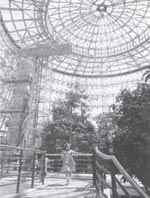
can be divided into two parts. The first is the Tropical Rain Forest
Greenhouse, which is the centerpiece and most obvious landmark of
the garden.
The greenhouse measures about 31 meters in height and approximately
56 meters in diameter. The outer frame is constructed of high precision
steel and glass. Inside is a simulated rain forest, complete with
rain, where you can walk along paths bordered by lush green plants
and tall trees or relax by a waterfall. In the basement, is an aquarium
featuring fish and other aquatic life from the Amazon River.
The second part of the Botanical Garden consists of the grounds
outside the greenhouse, which focus on Taiwan's lowland vegetation,
and are divided into several plant ecology exhibit areas that reveal
the characteristic flora and landscapes from a variety of regions
in Taiwan. Signs in English and Chinese give a brief introduction
to each area.
| There
is the central lowland area with deciduous plants and underground
cover found in the region between Ta-an Chi and Cho-shui Chi.
There is a collection of 66 plants in this area, and a small
hill atop which you can view the garden from a different perspective.
In the large northern lowland area, there are 80 species of
plants from the I-lan Plain, the northern coast and the Taoyuan
Terrace. This area is subdivided into tree ferns, dry river
valley and windward ridge. In the southern lowland (savannah
forest) area, there are 20 species of plants from the region
between Cho-shui Chi and Fong-kang Chi, covering Chia-nan Plain
and stretching up to Pingtung Plain. |
|
This is a very important agricultural region in Taiwan, but most
of the natural vegetation has been cut down and replaced by waste
grasslands. In the Taitung cycas (eastern lowland) area are 50 species
of plants, some with a very unique shape. Eighty species of tropical
plants in the Orchid Island area create a miniature of this volcanic
island located southeast of Taiwan. On this island, the Yami (Tau)
tribe has developed a unique ethnobotanical culture. The littoral
forest (strand forest) area includes 40 species of plants which
have light, fibrous and buoyant fruits that float, helping to develop
woods at the mouths of rivers, bays and on shallow shores.
In the monsoon rain forest area, there are dense thickets and flat
continuous canopies. Here, a collection of 60 species of plants
can be seen along four paths radiating from a central pool. The
coral atoll area in front of the Tropical Rain Forest Greenhouse
is one of the many highlights of the outdoor area. The 60 species
of coral atoll plants, sandy beach, water and waves, create the
feeling of a little Kenting. With more than 700 species of plants
in the greenhouse and outdoor areas, the visitor can enjoy the aesthetic
beauty while learning about plant ecology.
Also located on the grounds of the Botanical Garden is the Special
Exhibit Center. From now until January 2, 2000, the featured exhibit
is on succulents. Succulents are plants with thick fleshy leaves
or stems.
These fleshy parts are used to store water, as succulents usually
inhabit dry regions. The most familiar succulents are the desert
cacti. But, there are many other succulents featured, some with
very unique flowers and fruit, and even some from the high mountains
of Taiwan, as well as other regions of the world.
Also, don't want miss out on seeing the unique time-flow clock.
This clock is located on Hsitun Rd., near the path leading to the
greenhouse, and uses liquid flow to keep track of time. It consists
of a series of glass pipes with colored liquid. The flow of the
liquid drives the pendulum, and the time (hour and minutes) can
be determined by the heights of the liquid columns.
The Tropical Rain Forest Greenhouse and Special Exhibit Center
are open Tuesday through Sunday from 9:00 a.m. to 5:00 p.m. The
outdoor exhibit areas are open at all times. Admission to the greenhouse
is NT$20, and to the outdoor exhibit areas is free. The Special
Exhibit Center can be entered by showing your ticket stub for the
museum or the Tropical Rain Forest Greenhouse.
-- The National Museum of Natural Science is located at No.
1, Kuan-chien Rd., Taichung. Tel: (04)322-6940. Lights go out in
the outdoor exhibit areas at 10 p.m., and people should not enter
after that time.
|