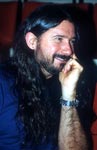
|
C:
With your busy schedule, you probably haven't had
much time to explore Taichung. However, have you been
able to form any impression of this city?
ML:
It's true that I haven't had much time to spend in
Taichung. But, my last visit here [in April, 2000]
to the National Museum of Natural Science was a very
rich one. After spending time in the museum, I had
the chance to go into the surrounding countryside
of Nantou. So, that was a memorable visit for me.
C:
You have acheived phenomenal success in Taiwan, especially
for a foreigner. Why do you think your music has such
widespread appeal here?
ML:
I get asked that question a lot. And, every time I'm
asked it, I have to take a look at the question again.
I guess I don't wonder why it is the way it is but,
rather, I'm just grateful for the way it is. I often
ask God why am I so blessed to be connected to a country
with so many beautiful people.
C:
Over the past several years that your music has been
distributed in Taiwan, have you seen any improvement
in the environmental causes you are active in or that
are at the center of your music?
ML:
Yes. When I first came to Taiwan, I was active in
trying to protect the Chi Lan Mountain old-growth
forest. In the few years since then, the government
has begun planning a new national park that will include
this forest. This park will be very large, connecting
Shei-pa, Yushan and Taroko national parks. In addition,
it was thought that involving the aboriginal people
in the development of this park would make the process
stronger. After meeting with Interior Minister Chang
Po-ya and other authorities, I feel that the government
is sincere in carrying out this process. I was asked
by the environmental organization that is working
to protect this area to identify two aboriginal representatives
from Canada with experience in incorporating aboriginal
concerns with the development of protected areas.
But, the rate at which all this is happening is quite
rapid. To develop a park in Canada may take decades,
but here the planning process will be completed in
just a few years. In addition, environmental protection
is one of the luxuries of democracy. As democracy
grows here, so will the opportunities for environmental
protection.
C:
Do you follow the mainstream music scene? Are there
any trends that you like or any local pop stars that
you would like to collaborate with?
ML:
I do follow local music somewhat. I'm not familiar
with all of the artists, but I like those with staying
power like David Tao and Ah Mei. Ah Mei is an extremely
talented aboriginal artist.
C:
Your album "In So Many Words" has just been released.
Does this album break new ground for you?
ML:
Yes, it does. As a musician, I process emotions through
music. In the past, I have focused on projects concerning
issues, regions and cultures and haven't had time
to deal with personal things. This album focuses on
personal messages. Also, the musical styles are different.
On this album, there are musical styles that I was
influenced by. The music is more aggressive because
I applied the style to myself rather than choosing
one I thought would be effective for an issue. Also,
the creation of this album was the goal. This was
a difficult album to make. It was all about the process,
not about what I wanted to achieve from this album.
C:
Your next project is one that is commissioned by the
I-lan [county] government to explore that region's
cultures and its environment. Have you begun recording
components for this project? Is there anything that
you can tell me as far as the content?
ML:
I started work on this project when I was originally
asked to do a song for a children's festival in I-lan.
That song included the singing of aboriginal children.
There are still some recordings of those children
left over and sounds that I recorded around I-lan.
I thought it would be beautiful to make the album
a journey of water through I-lan. For example, there
is Chi Lan, the many waterfalls, rivers and agriculture,
as well as the ocean with its fishing and ocean cultures.
The base of Kueishandao (Turtle Island) is the termination
point for an underground river with underwater volcanic
vents. I have an advanced SCUBA license, so I plan
to do underwater recording of the sounds from those
vents. I have so far identified aboriginal songs to
use and have done a lot of mapping out of the project.
But, I need to think about the songs and let them
steep for awhile and to spend time in different areas
of I-lan with the music and the musicians.
C:
You seem like a spiritual person. Where do you come
from on that side of things?
ML:
I have always allowed my emotional side to develop
in advance of my intellectual side. I have a very
personal relationship with Earth, with creation and
with my sense of God.
C:
Finally, is there anything that you would like to
say to the people of central Taiwan?
ML:
Taiwan has more than its share of challenges and struggles.
I am amazed by the strength of the people in the face
of these challenges. A reporter recently asked me
if I was afraid to come here this September because
of all of the typhoons. But, I feel like the people
of Taiwan are my family. When there is some trouble
where your family is, you don't think about the danger
of going there, you just obsess about how to get there.
So, with the recent typhoons this is where I wanted
to come.
|

Photo:
Henry Westheim © 2001 |