
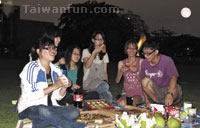
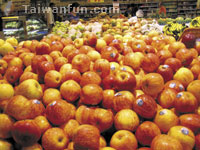
Pick up some fruit, cookies and
drinks for your family instead
of barbecuing during this
year's Mid-Autumn Festival.

The Taichung City Bureau of
Environmental Protection
requests that retailers indicate
carbon emission levels and
methods to reduce carbon
emissions on their BBQ
equipment.
|
Stop second-hand smoke: Enjoying a BBQ-free Mid-Autumn Festival
Words and photos by Taichung City Government
Translated by Naomi Lai
While nobody quite seems to remember when barbecues became such a popular Mid-Autumn (Moon) Festival activity, almost every Taiwanese family now celebrates the holiday in this fashion. Unfortunately, however, this popular pasttime has also turned Mid-Autumn Festival into an environmental disaster, covering most of the island in smoke for this one evening. The results of one night's worth of fun is both harmful to air quality and the human body, and runs completely contrary to the "carbon emission reduction" policies the government has been actively promoting.
Picnic, don't barbecue
This year, the Taichung City Bureau of Environmental Protection is promoting a public "Replace Barbecues with Picnics" campaign that encourages you and your family to instead enjoy the holiday under the moonlight with an outdoor picnic of some vegetables, fruit, moon cakes and beverages.
According to the Environmental Protection Bureau Director Mu Kuei-hsin, widespread barbecuing activities during Mid-Autumn Festival have impacted the environment. In Taichung, for example, if one third of the local population of approximately 120,000 families barbecues on that night using three kilograms of coal per family and producing 3.7 kilograms of carbon dioxide per kilogram of coal, they will produce approximately 1,300 tons of carbon emissions. If you apply the same math to the whole of Taiwan, these figures are dramatically higher. In other words, while we are having fun, we are also contributing to growing global warming.
According to bureau regulations, when the air-quality PSI index exceeds 100, the air quality is considered poor. During last year's Mid-Autumn Festival, over 50 air quality stations around Taiwan indicated poor air quality, two to three times the normal rate. There was also a 20 to 40 percent increase in carbon monoxide, and the airborne suspended particulate density reached 30 percent. Thus, the result of an evening of national celebrating was a big dive in air quality and big rise in air pollution.
Reduce coal usage and trash
Air pollution is not the only negative result from Mid-Autumn Festival barbecues, as charcoal in itself is a problem. Charcoal comes from carbonated wood and, according to statistics, it takes six to 10 kilograms of wood to create one kilogram of charcoal. That means Taichung City burns around 3,700 tons of wood on Mid-Autumn Festival alone. Apply the same math to the whole of Taiwan and during this holiday we burn off the equivalent of approximately 87 Taipei Da-An Forest Parks. It is no wonder environmental protectionists are against celebratory barbecues.
Another problem is the trash created by those who barbecue. Most of people use disposable dishes and dinnerware, resulting in massive amounts of trash. Director Mu noted that last year his bureau collected nearly 700 tons of trash following the Mid-Autumn Festival, which is more than 100 tons over average. Therefore, he hopes that when the public is admiring the moon and enjoying their snacks this year they will select food with less packaging and take recycling measures to help keep the environment clean.
Choosing your equipment
"Don't barbecue if you can avoid it," Director Mu Kuei-hsin says. The smoke released from this form of cooking may contain poly-aromatic hydrocarbons (PAH) which are harmful to the eyes, respiratory system and cardiovascular system. For the past two years, the Bureau of Environmental Protection has been promoting a reduction of barbecues and charcoal-free barbecues. Following these two years, the bureau conducted a survey of citizens over 18 and found that 84 percent of the public support this policy; that 60 percent believe the promotion has been successful; and that 90 percent agree with not cooking or barbecuing on park green areas. These results indicate a growing sense of social responsibility and conduct among Taichung's people.
If you really feel the need to barbecue in order to enjoy the holiday, the bureau suggests replacing regular charcoal with environmentally-friendly charcoal, or electric and gas grills. The bureau has also invited various retailers to hold further promotions for environmental protection, and requested that they indicate carbon-emission levels and methods to reduce carbon emissions on their products. At the same time, officials are encouraging the public to use low-polluting barbecue equipment to reduce the impact on the environment.
Love our planet. Act now!
 Comparisons of carbon emissions by store-bought
BBQ equipment for a family of four.
●
1.85 kilograms of carbon emissions per 0.5 kilograms of charcoal per hour.
●
0.638 kilograms of carbon emissions per 1 kilograms of gas per five hours.
●
0.83 kilograms of carbon emissions per 1,300 watt/hr of electricity per hour.
●
0.954 kilograms of carbon emissions per 1,500 watt/hr of electricity per hour.
|

 September 2010

