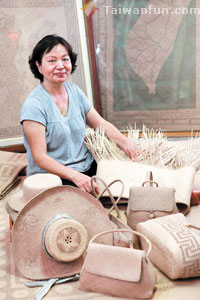
Chu Chou knows all kinds of
weaving techniques and is
good at using them for
different creations.
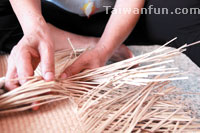
To make a mat, the process
takes place from bottom to top,
as weaving can only take place
on its reverse side.
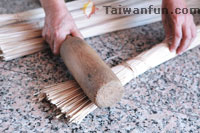
Pounding makes the grass
tougher and finished products
more durable.
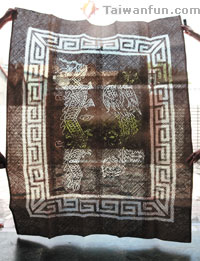
The difficulty of making a
"Longfeng Xi" product makes it
a symbol of excellent
craftsmanship.
|
A cool breeze in the hot summer
Chu Chou Kui-chun: The key to the survival of Dajia'a rush-grass industry
Words by Ye Jia-hui
Photography by You Jia-huan
Translated by Angel Pu
On June 7, as Taiwan temperatures hit 36 degrees Celsius, the highest of the
month to date, Chu Chou Kui-chun holds a pillow in a rush-grass case--made by
herself--against her face. "We have always slept on rush-grass mats since we
were young. They're airy and cool and I always feel much better when I lie on
these mats and smell the scent of rush grass, she says.
The 67-year-old Chu Chou Hui-chun looks younger than she really is. She got married when she was still a teenaged girl, and now most of her children and grandchildren are taller than she is. One of her favorite things, other than seeing her children and grandchildren during their visits, is hearing them ask her to make them some rush-grass mats and hats.
A family factory run by women
Like most Dajia residents born during the 1940-1950 period, Chu Chou Kui-chun began learning how to weave rush grass when she was about 5. Dajia's rush-grass industry flourished greatly at that time, and Taiwanese products were exported to Japan, Europe, America and China. This was a time when just about every woman at home in Dajia worked hard to produce rush-grass mats and hats, so that their incomes were sometimes even higher than the men's. "No woman dared to marry to Dajia's men if they couldn't weave rush grass," recalls Chu Chou, talking about the unique Dajia phenomenon that saw women with a higher position than men at that time.
Thanks to her grandmother's tutoring from the time she was a child, Chu Chou became an excellent rush-grass weaver. After she was married, her outstanding skills helped her husband's rush-grass business flourish. However, Dajia's rush-grass industry began to decline in the 1980s because of China's much cheaper products, and Chu Chou and her family were forced to relocate to northern Taiwan in pursuit of a better living. It was not until 1992 that she returned to hometown Dajia and had got a fresh chance to show off her fine craftsmanship.
Choosing the right kind of rush grass starts a complicated process
According to Chu Chou, the weaving process can never begin without the selection, picking, pouding, and kneading of rush grass. Although wild rush grass grows along the Dajia River, farmers began cultivating it in paddy fields after it became an important money-earning crop. The best-quality rush grasses are harvested in the seventh and eighth lunar months and are the best materials for producing high-end rush-grass products because of flexibility and beautiful color. These grasses are sun-baked before being sent to the weavers who, upon receiving the grass, select undamaged products and sort them by color to ensure that finished products are the same.
After selecting good-quality rush grass, the weavers have to rip open the grasses with sewing needles. "This is the most difficult part for me at this age because it really requires good eyesight," says Chu Chou as she puts on her reading glasses. She squeezes a needle tip into a grass stalk, makes a twist with her index and middle fingers, and suddenly it is cut open. Upon closer examination, you will find out that the shape of rush grass is actually triangular, and that its center is filled with a spongy material. That was why, besides "Dajia Rush Grass" and "Mat Grass", rush grass is also known as "Triangular Rush Grass". A single rush grass stalk can only be cut into a maximum three parts and the finer and thinner it is the more expensive and exquisite the finished product will be.
After tying the ripped-open stalks into bundles, the weavers begin to pound them with wooden hammers. The goal of this process is to toughen the grass so that the finished products are more durable. The longer the grass is pounded, the softer the finished products will be. Next, Chu Chou takes out a bamboo winnowing basket, moisturizes the grass by spraying it with some water, and starts kneading it like making bread. This process also helps make the rush grass softer and easier for weaving.
Learning Dajia's own 'Longfeng Xi' without a teacher
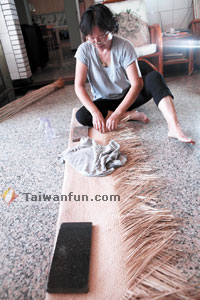
On this day, Chu Chou demonstrated the making of a basic square Dajia rush grass mat. Grass mats require weaving styles that are different from grass hats. To make a hat, the weaver begins weaving from the center of the crown. To make a mat, the process starts from the edge of the mat, from bottom to top, and weaving can only be done on the reverse side of the mat. For example, if you wanted to weave characters or patterns, they would be woven upside down and reversed horizontally, so the weavers have to be good at directions and order. Thus, when it comes to rush-grass handicrafts, the most famous, and most difficult, technique is creating a "Longfeng Xi" dragon-and-phoenix mat.
It is already a time-consuming task to weave a complete, flawless mat, so weaving a lively dragon-and-phoenix pattern without a template is difficult beyond most people's imagination. According to Chu Chou, Dajia became famous for its mats and hats because these were exported from the town. However, when it came to production, items made in Miaoli county's Yuanli were actually better than Dajia's. This explains why famous craftsmakers able to produce "Longfeng Xi" were all from Yuanli, although Chu Chou is the first person to learn "Longfeng Xi" without a teacher. After looking at other people's work and figuring out how to do it in her mind, she finally began producing her own style of this specialty.
A grandmother's love passed down to the next generation
"My wife can do this because she is good at it, and she's also gifted. She figured it out all by herself; no one had ever taught her," said Chu Chou Kui-chun's husband, responding to common questions during her Longfeng Xi exhibition about how it was possible for someone to master this difficult technique without a teacher. Chu Chou has indeed been the first person from Dajia to make a "Longfeng Xi" product, and when her child married, she made yet another one as a gift for the newlyweds, underlining her ability to do this by herself.
Although Chu Chou has stopped making rush-grass products to earn a living, she still loves doing it as a hobby. She may not be able to see as clearly, she can't sit or squat for a long time, and her fingertips always seem like they have been sandpapered, as she has been ripping up grass stalks since childhood. But she still loves to make mats, pillowcases and hats with her children and grandchildren's names on them. As a mother and grandmother, Chu Chou remains soft and fragrant, just like her rush grasses.
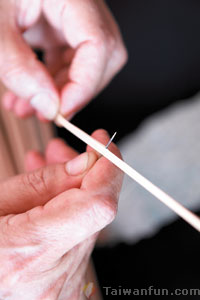 
Left: Ripping the grass with sewing needles is time-consuming, tough work.
Right:
During the production process, a mat has to be placed on the ground and fixed with heavy objects, making it easier for weavers to create a beautiful final product.
|

 July 2012

