Promoting a Smart Ride app for smart transportation
'579' Bus Routes open in March
Words by Jian Zih Qi Translated by Anna Yang
Photos by Reflection Photography
Photos provided by Transportation Bureau of Taichung City Government
Prevention is better than a cure. In order to prevent traffic accidents, the Taichung City Government Transportation Bureau has developed the first "Live Traffic Platform" in Taiwan and its promotion of the Smart Ride app will help residents exercise more caution while driving. The city government will also open "579" bus routes on March 1, providing express services to main stations only. However, buses will also stop at schools along these routes before and after school hours, offering improved transportation time management to students by comparison to original routes and stops.
A word beforehand is worth two afterwards. The city government has developed a "Live Traffic Platform" in order to enhance residents' safety and prevent traffic collisions. Traffic report data and statistics have been utilized to provide information about accident frequencies, location and color magnitude diagram for traffic, the highest collision-risk population, and collision times. The city government aims to boost transparency regarding all traffic cases to establish professional systems and databases. In addition, the above analyzed information will be updated on the new app, which will provide residents with a convenient means of researching traffic accident information when the service begins this year. As drivers approach higher-risk intersections, the app will even give an automatic voice warning, reminding drivers to exercise caution while driving.

The Smart Ride app provides an instant look at information regarding traffic accidents and
higher-risk crossroads.
Smart Transportation Center of Taichung City to be completed in 2017
Transportation Bureau Director Yi Chuan Wang notes that the rapidly-progressing Smart Transportation System's "Transportation Management System Aggregation" will enhance people's reactions and actions when witnessing a traffic accident. Furthermore, the "Smart Input Statistic System" aims to strengthen decision-making and service efficiency, while the "Multi-Information Service System" constantly provides integrated transportation information to drivers on the roads. However, all systems can only be used independently, making it mandatory to integrate them in order to create a "Smart Transportation Center of Taichung City".
This smart city transportation network, expected to enter service in 2017, acts a bit like a "spy in the sky", collecting information on public buses, parking, the iBike system, traffic reports, high-risk road sections and other data. It then analyzes the provided information and services. This information can also be utilized to assist police and fire departments in consolidating efforts and boosting response and rescue efficiency and capabilities.
Starting March 1, '579' Bus Route system saves time with main station-only express services
With Taiwan Boulevard's dedicated bus lanes earning a good reputation for excellence, the city government now plans to launch 500, 700 and 900 numbered bus routes on March 1. The Green Line "500" bus routes along ZhongQing Road will travel from the Daya-Zhongyi area to Taichung Railway Station. The Orange Line "700" buses will follow Chongde Road and travel from Fengyuan District to Taichung Railway Station. The Red Line "900" bus will follow the intercity Highway No. 3 and only stops at main stations and school stations. The fronts of buses in this new system will be distinguished by green, orange, and red colors.
Bureau Director Wang says that the new "579" bus routes will travel along three main Taichung City thoroughfares. Because buses previously made frequent stops between stations and added to traffic congestion, the city government analyzed 200 million pieces of data and statistics to single out 20 main stations along the bus route. With added stops for elementary and high schools, this left approximately 23 to 27 main stops. This is less than half of the original number of stops on old bus routes, meaning that riders can save up to 20 minutes on the new "579" bus routes. The success of Zihciang bus routes along the coastal line created previously by the city government can be attributed to such factors.
The new routes on three main roads are mostly being provided for student use before and after school and the service is being offered during peak hours, from 6 to 8 a.m. and 4 to 7 p.m. Buses arrive every 10 minutes, amounting to 64 buses on each main route per day. Students will thus be able to save 10 to 20 precious minutes spent rushing to the bus stops. At the same time, original bus route numbers 6, 12 and 55 will remain unchanged and continue stopping at local stations for riders' convenience. Thus, residents have the option of taking buses during peak or off-peak hours and will be less affected by rush hours. The new "579" bus routes will be named with bus numbers beginning with 5,7 and 9 as a precedent for bus lines on Taiwan Boulevard in the very near future.
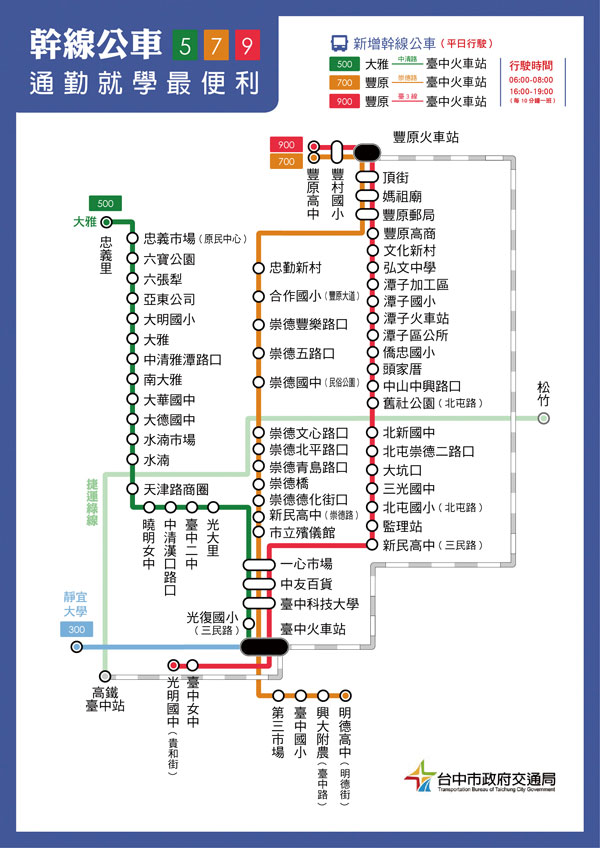
"579" bus routes map

"579" bus routes serve express stops only and can save riders 20 minutes
per ride.
|

 March 2016

