From our archives, Compass Magazine, November 1999.
In an idealized existence, a people and country which had just suffered through some natural calamity could simply continue on with life from the point at which it was interrupted. Soon, everything would return to normal and everyone would move forward towards bigger and better things for themselves.
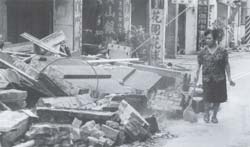
In the real world, there is nothing farther from the truth. A disaster of great scope and impact, such as the September 21 earthquake, leaves a long swathe of carnage — destroyed and forever-altered lives, broken buildings, lost property, damaged psyches and much more — in its wake.
Many people and places will never be quite the same again and the goal of recovery is one that will require years of painstaking work and commitment by individuals and society. In the weeks since Taiwan’s disaster of the century, now commonly known as the 921 Earthquake, the initial dazed shock and horror of central Taiwan residents has been replaced by the realization of what lies ahead for the region. Despite Central Government pledges of assistance and help from other sources like the military and relief organizations, the reconstruction of crowded urban centers and isolated mountain-top villages alike is already stretching various resources to the limit. At the same time, frustration among those who have lost homes and property has noticeably grown.
Included in the immediate tasks at hand are the provision of suitable alternate arrangements for an estimated 100,000 homeless residents. Many of these people spent much of September and even October living in tents and makeshift shelters. Three government options are being presented to them: placement in temporary housing, a NT$3,000 per person per month rent stipend, or the opportunity to buy national housing units at 30 percent below market value. Those who have partially or totally destroyed homes are also eligible for government assistance of NT$1 million and NT$2 million respectively. Even so, many residents have noted that such sums are insufficient to get back on their feet again. Although many, even most, homeless residents are reportedly opting for the rental stipend and making their own housing arrangements, many others will be spending at least the next one to two years in tiny temporary homes, measuring between eight to 12 pings in size.
Most have a combined living room/kitchen/dining room area, two or three bedrooms and a bathroom, together with power, gas and running water. The government has noted that it may put up as many as 5,500 of these units, while others are being built by non-profit organizations, such as the Buddhist Compassion Relief Tzu Chi Foundation which, in turn, could also build up to 2,700 units.Land has been cleared in parks, former military depots, public squares and other areas for these instant communities. Although builders are attempting to brighten up cramped developments with green areas and activity centers, life certainly will not always be easy for households in tiny temporary shelters. Psychiatrists, relief organizations and religious groups already anticipate the need for counseling and other assistance to these people. On the psychiatric side, doctors have already noted that similar environments have historically bred what is referred to as “camp syndrome,” which includes an increase in stress, interpersonal conflicts, crime, sexual abuse and promiscuity, and gangs.The task of housing the homeless is joined by other major projects to rebuild many damaged or destroyed schools, roads, bridges and other public-use structures. At the same time, work has rapidly progressed to destroy damaged structures. Visible damage aside, another just-as-important job lies ahead — treatment of psychological wounds and scars left on tens of thousands of people by this tragedy. Most residents who directly experienced the quake have felt at least some trauma-related symptoms, including nightmares and the well-known rocking sensations that have continued to plague many. However, the next several months will begin to differentiate between those whose symptoms disappear and who fully recover and those who do not. Post-traumatic stress disorder, as long-term problems are frequently categorized as, can result in an inability to cope with everyday life and even personality changes. Treatment for such cases includes group and individual counseling and the administering of anti-anxiety and anti-depressant drugs. Doctors believe the current number of psychiatric cases to be only the tip of the iceberg and expect cases to steadily increase. To cope with this and limited mental health care resources, local hospitals and doctors have formed the Central Taiwan Earthquake Mental Care Alliance, which consolidates resources and assigns responsibility for specific geographic regions to individual hospitals. In Taichung City, special telephone hotlines have also been established to provide counseling and refer people to professional care. Psychiatrists, noting that there has been a long-time stigma in Chinese culture about seeking professional psychiatric health, are providing general advice to help the public cope with normal human responses to any trauma. With care, most people –although not all people — will be able to fully recover from the fear, anxiety and other troubles that they currently face. (See Compass check lists.) At the same time, the mental care alliance is also working through hospitals, schools and other channels to identify potentially-serious cases and treat them.Particularly at risk in these traumatic situations are the elderly and adolescents, according to psychiatrists who plan to monitor these groups especially closely.In the short-to-medium term, central Taiwan will face many other tasks. On the economic front, particularly hard-hit were the tourism and service sectors which are both pillars of local economic development. The central part of the island has been the most popular local tourist destination and now must see the rebuilding of dozens of hotels, resorts and other tourism facilities. At popular Sun Moon Lake, for example, all major hotels were destroyed or damaged and local residents — who rely on tourism for their livelihoods — believe that it will take two to five years to recover from the quake.Whether dealing with minds, businesses or buildings, reconstruction is a many-faceted challenge that will require the involvement of all sectors of society, plenty of outside help and a commitment by all not to forget the job is not winding down.


 何道明 Douglas Habecker


Comments
0 comments