

 taiwanfun
by Cheryl Robbins
From our archives, Compass Magazine, January 2000.
One of the world’s most admired women, Dr. Jane Goodall, recently visited Taichung’s National Museum of Natural Science to deliver a message which she entitled “Reasons for Hope.”
Goodall gave her audience four reasons for having in hope: the human brain, the resilience of nature if given a chance, the tremendous enthusiasm and energy of young people when they are aware of the problems and are empowered to act and the human spirit.
“The human brain is quite remarkable,” she said. “We can now communicate electronically. Medical science has helped to increase life expectancy and there is advanced technology which Taiwan can use to rebuild itself after the earthquake.”
Jane places much of her hope for the future in young people. In 1991, she started a program called “Roots & Shoots,” designed for students from pre-school all the way up to the university level to help their environments and communities. There are now 15,000 “Roots & Shoots” groups worldwide, all carrying out projects that focus on animals, human communities and the environment. Now is an ideal time, she said, for young people in Taiwan to help those devastated by the 921 earthquake.
Collecting and sharing stories of how the human spirit overcomes enormous obstacles is one of Jane’s hobbies. She told of her visits with earthquake victims in Puli and Tungshih, and how she witnessed them rebuilding their lives and others working selflessly to help their friends and neighbors who had lost everything.
Goodall’s beginnings
Goodall’s interest in the spirit of animals fully surfaced when she started her research in Tanzania’s Gombe National Park.
Dr. Louis Leakey, a well-known archaeologist and paleontologist, was seeking out someone to study Gombe’s wild chimpanzees. Goodall found Leakey and shared her enthusiasm for studying wild animals in Africa. But, that was 1960. And with Tanzania under British rule, authorities balked at the idea of a young woman living alone among wild animals in Africa. Goodall finally got approval when her mother volunteered to accompany her.
Goodall’s arrival in Gombe in 1960 was the start of what is now the longest-running field study of any one particular group of animals. The study is still running today. Goodall spent years naming each of the more than 100 chimpanzees she watched, describing their individual personalities and emotions. One of her most startling discoveries was that chimpanzees make and use tools. She observed “David Graybeard” stripping the leaves off of a twig and using it to scoop up ants.
This was a major discovery because at the time, man was defined as “the toolmaker.” When Goodall informed Leakey of her findings, he responded, “We must redefine man, redefine tools or accept chimps as humans.” It was this observation which prompted National Geographic to continue funding Goodall’s studies.
Human hope
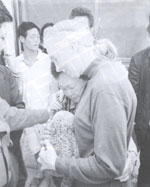
Jane brought along her mascot, a stuffed monkey called “Mr. H.” Mr. H. was given to her by Gary Horn, one of her most “inspirational friends.” Gary went blind when he was 25. But instead of allowing his blindness to interfere with his life, he learned magic. He now performs children’s shows and has developed his skills to such a degree that the children have no idea he is blind until he tells them. Jane says that Mr. H carries some of Gary’s human spirit and that those who touch it can take some with them. Mr. H has so far been touched by more than 500,000 people all over the world, including some of Taiwan’s earthquake victims.
So, with all of these reasons for hope, Jane encouraged the audience not to be apathetic. “The biggest hindrance to improving things is that people don’t feel that they can make a difference,” she said. “But, if we each make an effort, such as buying products only from environmentally friendly companies, together we can exact a difference.”
Jane’s visit to the National Museum of Natural Science was the kickoff event to a new exhibit called “International Photography Exhibition of Nature.” This exhibit will run until February 27, 2000 and is divided into 3 sections: “Taiwan,” “Tiger” and “Gombe.”
Photographs of the island’s natural beauty and intriguing wildlife are featured in the Taiwan section. In the Tiger section are spectacular photos of one of nature’s most magnificent creatures. In the Gombe section are photos featuring Jane’s three loves: chimpanzees, Africa and children. National Geographic videos in this area include “The Photographers” and “Life and Legend of Jane Goodall.” All of the National Geographic videos are in English with Chinese subtitles.
This exhibit is located on the first floor of the Life Science Hall of the National Museum of Natural Science. No. 1, Kuan-chien Rd., Taichung. Tel: (04) 322-6940, ext. 596. 597, 598, 298, 398 (information desks). Museum hours are 9 a.m. to 5 p.m., Tuesday-Sunday.


Comments
0 comments