

 taiwanfun
From our archives, Compass Magazine, Dec. 1998:
By Barbara Healy
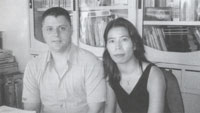
Don Soloma looks just as comfortable in Taiwan as he would on a patch of his suburban homeland in Melbourne.
That comfort hasn’t come without some hard work and lots of vision. Nearly five and a half years ago, he and his Taiwanese wife, Mia, pooled their talents to build Mia English School, now situated in east Taichung on Han Hsi Road.
Within the gates of this orderly establishment are some features that would make anyone want to return to childhood and enroll in its programs. Walking into the boundaries of Mia English School is like walking into a piece of Australia.
For Don, exceptional and innovative education far transcends the parameters of the classroom. The school, with its vibrant and upbeat colors and murals, and a generous playground facility securely enclosed in a well groomed spare lot adjacent to the school, carries the philosophy of its founders. The campus, which accomodates children from preparatory (kindergarten) through 6th grades, has an incredibly safe, yet open, atmosphere.
With telephones ringing and students and teachers zipping in and out of the school’s office, Mia English School buzzes with life.
“Our lessons are theme-based,” Don begins to explain. Don outlines the study materials so that parents, students and other teachers can thoroughly partake in the learning process. Just as lesson plans are specifically outlined, so are learning goals for each age group. What the child will be taught and should know within a year’s time is spelled out clearly on paper for easy reference.
The school also offers evening language study classes, a summer camp and, amazing as it may sound, an actual study trip to Australia. The field trip allows students to visit the sister school near Melbourne for a couple of weeks. Though Don admits that, at first, he was apprehensive about the program. “I wondered if the children, mostly ages 6 through 14, would get all the way there and immediately wish to return home,” he explains. “Instead, they absolutely loved it.”
Not only do the students polish their English skills, but they are able to become immersed in the daily life of Australia, interacting with other students and observing everything from what they study to what they eat for lunch (he did not mention whether any of the students were bold enough to sample Vegemite sandwiches).
This year’s study tour went to Parkmore Primary School in Forest Hill, a suburb of Melbourne. Since the school teaches Mandarin as a language elective, the venue was suitable for Mia students. Outside of class time, students visited Australia’s sights, including marine centers, shrines and wildlife parks.
Don’s interest in and commitment to this sort of creative education began back when he was still in school. He earned his Diploma of Primary Teaching and Bachelors of Education in TESOL (Teaching English to Speakers of Other Languages) and then went on to earn a Masters of Applied Science in Linguistics at LaTrobe University, where he also met his future wife, Mia. Don’s first teaching job was at Richmond West Primary School near Melbourne, a school which had a population consisting of 96 percent non-English speaking (as a first language) students.
In 1989, armed with this educational background and some work experience under his belt, Don was awarded an International Teaching Fellowship and landed an assignment in Jiang su, China.
Don admits he had no choice but to become completely immersed in the Chinese language and culture at Nan Tong School in Jiang su where he taught Chinese students who were studying to become high school teachers.
After this adventure, Don married Mia and they moved to Taiwan, near her family. “I really wanted a break from teaching at this time,” Don said. He and Mia intended to do something different in work and he wanted to continue studying Chinese.
It wasn’t long, however, before the role of educator caught up with Don once again. In the neighborhood where Mia School now stands — the same place where Mia’s family lives — was a handful of youngsters who needed someone devoted to quality education. That’s when Don re-entered the picture. Five or six students soon turned into 15 or 16, and then the need for a facility became evident.
Don and Mia’s hard work was just beginning. The two started from ground zero, building the school from ground up.
Mia was instrumental in dealing with contractors, licensing, safety issues and overall communication in the construction process. Don spent his time meticulously researching resources, making contacts, transporting various and sundry materials from Australia, New Zealand and Canada, where he had established top quality contacts. After much painstaking care, the school was up and running. Now there are between 100 to 120 students enrolled.
Subjects range from language, science, music and mathematics to art, gymnastics, and drama with games and storytelling mixed in.
The school uses state-of-the -art computers (IBM and MacIntosh), and a telescope can be used by all of the students. One Chinese and one English-speaking teacher work together to teach in each class, which each average 15 to 20 students.
And what about the future direction of Mia School? “If I were to create another school, I would add a second story for a library,” Don said. He explains that he is satisfied with the current one-story school, but says that the office is overflowing with children’s literature.
It is hard to believe, with a regimented schedule from 8:30 a.m. to 9 p.m. six days a week, that Don and Mia have any spare time at all. They do manage, however, to find the time to take lessons in a Shotokan Karate class.
Don and Mia look forward to their future together and to continuing what they have built. With their enthusiasm, they are certain to stay committed to the education of their students and to enhancing the lives of those who share they passion for excellence and a creative, cross cultural learning experience.


Comments
0 comments