
 taiwanfun
From our archives, Compass Magazine, May. 2002:
By Rachel Chiou and Tammy Huang Translated by Jacques van Wersch
The first and strongest impression one gets while strolling Lukang’s streets is that of tranquility. But ask any old-timer about Lukang’s past and you will be told about the hustle and bustle of what once was one of Taiwan’s busiest ports. How did this place go from being a principal city to a sleepy backwater?
“Lu” (鹿) means deer in Chinese. Historical records show that central Taiwan was once heavily populated with deer. Apparently, herds of them used to congregate in the meadows adjacent to Lukang’s natural harbor. The Dutch began exploiting Taiwan’s deer for trade in the 17th century and the deer pelt and venison trade continued to flourish into the early Qing era. The harbor (“kang”–港) and city were named by Chinese traders who identified the place with the deer herds and began variously calling it Luzikang, Luzihsi, Luhsi and Lulu. Lukang is the name that stuck.
Lukang does not cover a particularly extensive area but is located close to the Changhua plains, a major rice-growing area. Its natural port, with deep water and sheltering peninsulas, made it one of the best harbors in Taiwan for late-Ming and early-Qing era traders. In fact, it was ranked as one of the biggest commercial and cultural cities in Taiwan at that time.
Originally, the area was populated by Pingpu Aborigines of the Babuza tribe. Later, Lukang also became home to Chinese and Hakka immigrants from Fujian’s Xinghua, Quanzhou, Zhangzhou and Canton (Guangzhou). Immigrants from these different regions each built their own temples. For example, new residents from Xinghua built Xingan Temple, while their counterparts from Zhangzhou built Nanching Temple and Hakka settlers from Canton built San Shek Wan Temple.
Lukang’s harbor was closed to large ships at about the turn of the 19th century as deposits from the river began to silt up the harbor. Eventually, ships quit stopping at Lukang altogether. However, the city continues to be a repository of important building styles. Temples are the main attraction. On such a forward-looking island as Taiwan, it is rare to find a city with such a high concentration of historical buildings as one finds in Lukang.
Below are descriptions of a few of Lukang’s attractions:
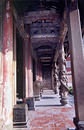
Longshan Temple
Longshan Temple covers 9,600 square feet and is classified by the government as a “Class A” historical site. It was built during the 18th century and is universally lauded for its architectural excellence. It is even hailed by some as “Taiwan’s Forbidden City” for its solemn grandiosity.

Tianhou Temple
There is always a crowd of worshippers at Tianhou Temple. A treasured Matsu figure sent across the Straits from the Meizhou temple is on view in the temple’s sanctuary. Tianhou is an excellent example of temple architecture. In the rear hall, there is a display of historical and cultural relics.

Civil Shrine Martial Temple/Wenkai Academy
More than 300,000 sacred texts are housed at this shrine-cum-temple-cum-school, built by a group of officials and literati living in and around Lukang in 1824. The Wenkai Academy played an important role in nurturing cultural awareness in 19th-century Lukang.
Nine-Turns Lane
Now known as Chinsheng Lane, this thoroughfare was originally named after the northwesterly “September Winds”. (The “nine” in Nine-Turns echoes the “nine” that refers to September, the ninth month.) The first immigrants built their houses in a T-shape rather than in the standard cross configuration in order to diminish the wind’s effects. This is the source of the lane’s many curves.
Lukang Gates
In the old days, there were often clashes between immigrants from different clans. If a brawl broke out, those with no stomach for fighting could flee to the safety of their clan’s “narrow gates” (隘門), which outsiders dared not enter. Thus, these gates came to serve as lines of defense and borders between clan districts.
Shih Yih Hall
Intersecting Chinsheng Lane, you will come across an elevated corridor known as Shih Yih Hall that, in former times, was the hangout of Lukang’s literati, who would gather there to recite poetry and partake in alcoholic revelry.
Walls of Jars
One of Lukang’s peculiarities is the use of empty jars of Shaoshing wine to build ornamental yet practical courtyard walls.
Xingan Temple
Xingan Temple, like most early Matsu temples, was constructed without posts and room divisions, giving it a simple but elegant appearance.
Shinzu Temple
The Shinzu Temple is the only Matsu temple built by the decree of the Qing emperor Qian Long. This temple was designed for use by imperial officials, giving it its palatial style. The four commemorative stone tablets on the right as one enters are of great historical value.
Lukang Folk Arts Museum
This baroque-style structure was built during the Japanese occupation and now serves as Lukang’s folk museum, housing an array of traditional artifacts.
Remembrance Hall
This Southern Chinese-style building was originally a woman’s living quarters. The building is well-known locally for the romantic lore associated with it.
Lukang Balustrades
Lukang’s characteristic carved balustrades allow for effective convection of air and transmission of light.
Stone Warning Tablets
Local superstition has it that certain locations–such as T-intersections, river banks and ferry docks–are inauspicious. Thus, stone tablets carved with the words 石敢當 (“Shigandang”, meaning “resolute”) were placed in such places. These words were also carved onto stone walls. It was thought that the power of these three characters placed together could ward off evil spirits.
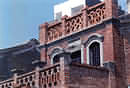
Half-Sided Well
Half of this well was made available to passersby and less-fortunate neighbors by a generous owner more than a century ago. The public half is separated from the private half by a wall.
Word-burning Stove
Located near the Longshan Temple, this spot was reserved for the burning of paper in former times. Paper with written or printed words was particularly cherished, and wasn’t customarily thrown out with other garbage. Instead, Lukang residents would unload their unneeded–but still cherished–paper here.
A Lukang dining and shopping guide
In addition to noteworthy historical sites, Lukang possesses numerous restaurants and traditional handicraft shops.
Eateries near Tianhou Temple and No. 1 Market
Yu Chen Chai
Address: 168, MinTzu Road, Lukang
Tel: (04) 777-3672
Hours: 8 am-11 pm
Tourists and worshippers visiting Tianhou Temple will almost certainly find themselves eating Lukang-style oyster omelets at one of the restaurants located on Min Sheng Road. If the oyster-stuffed omelets (NT$40) don’t satisfy your craving for the tasty bivalves, you could add oyster soup (NT$40), or raw oysters (NT$80 per plate) to your order. If oysters aren’t your thing, opt instead for mud shrimp or mullet (black fish).
You might want to round off your meal with cow tongue pastry–yet another Lukang specialty. Unlike I-lan’s crispy cow tongue pastry, Lukang’s are soft in the middle. Around the No. 1 Market, you can find other local favorites such as oyster vermicelli, thick duck soup, and five-flavor stir-fry.
A trip to Lukang without a sampling of the local delicacies is unthinkable, so take advantage of your visit to try as many foods as possible. Be sure to save some room for treats like the phoenix-eye cake, phoenix egg cake, and green bean cake at Yu Chen Chai, which makes hundreds of appetizing pastries. Yu Chen Chai has been around for five generations (more than a century), making it a tourist attraction in its own right.
A-Chen Steamed Buns
Address: 71, JungShan (ChungShan) Road, Lukang
Tel: (04) 777-2754
Hours: 9 am-7 pm
You’ll also want to try some of A-Chen’s steamed meat buns. A long line forms in front of this shop every day at about 3 p.m., with people anxious to bite into these buns, featuring a firm dough wrapper and perfectly-prepared meat filling, still steaming in its savory juices. A-Chen’s buns are made fresh on the premises every day. Once you taste them, you won’t mind waiting your turn in line even for a couple of hours to get another taste. Steamed buns are NT$15 each and NT$150 for a box of 10; plain mantou (steamed bread) is NT$6 each; whole wheat mantou is NT$15 each. If you want to buy mantou, you should start to queue especially early.
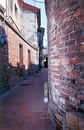
Old Market Street
Collecting traditional handicrafts is a recent trend in Taiwan. Lukang is an excellent place to do just this, particularly along the main streets in the old part of the city–PuTou, YauLin (YaoLin) and TaYou (DaYu) streets. These thoroughfares, which run parallel to the river, still retain their Qing Dynasty charm and the area has been designated as a protected heritage site.
The red-tiled streets are lined with shops selling crafts and toys as well as old-fashioned clothing, like ladies’ qipao (chipao) dresses and mens’ gowns. You will also come across shops selling exquisite brocade shoes and other nostalgic paraphernalia, including classical and modern handbags, wallets, and notebooks. Prices range from NT$150 to NT$800.
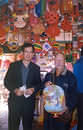
Wu Tun-hou’s Traditional Lantern Shop
Address: 312, JungShan (ChungShan) Road, Lukang
Tel: (04) 777-6680; 778-9375
Hours: 8 am-11 pm
You can find all kinds of lanterns in the shop next to Lukang’s police station. Although it isn’t large, Wu Tun-hou’s Traditional Lantern Shop is well worth a visit. On the walls are numerous photographs of proprietor Wu Tun-hou with famous local and international personalities. If you’re not impressed with the company Mr. Wu keeps, you will be impressed with his lanterns, which he has been making with traditional techniques for 65 years. Collectors from 38 countries have purchased his works, which many believe transcend handicrafts and in fact are genuine works of art. In 1982, Nobel Laureate Yasunari Kawabata visited Wu’s shop to pay his respects. The craftsman/artist, now 81, considers himself a custodian of traditional culture and is always pleased to see his craft getting the respect it deserves.
Lukang Pottery
Address: 81, KinMen Lane
Tel: (04) 776-6230
Hours: 11:30 am-6:30 pm; 10 am-8 pm holidays/weekends
Hands-on pottery making 2-4:30 pm, except holidays
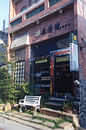
Once you’ve appreciated Lukang’s extraordinary architecture, gotten your fill of the local delicacies and stocked up on handicrafts, you might be ready for a change of pace. Lukang Pottery, located in a lane near the side entrance to the Longshan Temple, is just the place. After taking a look at the pottery on display on the first floor, and maybe purchasing some, you can head up to the second floor to drink a cup of coffee or sip some other beverage while munching on snacks.
While you’re relaxing, you’ll probably get a chance to talk with your host, Mr. Hui, whose pottery you appreciated down below. He’ll be able to tell you what gives Lukang pottery its distinctiveness, namely wood ashes, rice plants, oysters and gold foil that go into making the works. The pottery here is pinched into elegant forms whose unadorned simplicity defines their beauty. You can also have a go at making your own pottery for NT$150 per person.
Getting To Lukang
By Bus:
1.From Taipei’s Chunglun Station on PaTeh Road, take the Chunghsing bus directly to Lukang (departing on average every half hour).
2.From Taichung or Changhua, take a Changhua Bus Co. coach directly to Lukang.
3.From Yuanlin or Hsihu, Yuanlin Bus Co. coaches depart directly for Lukang.
By Car:
1.Southbound drivers can take the Changhua freeway exit to County Route 142 for about 11 kilometers.
2.Northbound drivers can take the Yuanlin freeway exit to County Route 148, and then switch to County Route 135. Lukang is about 16 kilometers from the freeway.
You need to be in good shape to get around Lukang. You might consider renting a bicycle rather than driving from site to site. Getting around on a bicycle is also less fatiguing than walking the length and breadth of the town. You can rent bicycles at Sichih Teahouse for reasonable rates. In addition, you can drop off your rented bike for free at the Wenkai Academy. Tel: (04) 777-4622
Rental Rates:
NT$150 per day (see business hours below), or NT$30 per hour
Hours:
10 am to 10 pm weekdays; 9 am to 10 pm on weekends and holidays (reservations are recommended on weekends and holidays)


Comments
0 comments