

 何道明 Douglas Habecker
By Douglas Habecker
From our archives, Compass Magazine, July 1999.
Mention a World Trade Center and most people will think of the monolithic twin towers in lower Manhattan, or perhaps the sprawling, sand-colored complex in Taipei. However, there are probably a good number of visitors and even residents who do not know about Taichung’s own World Trade Center, or who have at least never paid a visit.
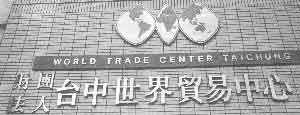
Despite the fact it maintains a much lower profile than other counterparts around the globe, the World Trade Center, Taichung’s (WTCT) purpose is similarly crucial to the development and internationalization in the city it serves. Surrounded by park-like grounds in the Taichung Industrial Park, the WTCT opened nine years ago as the island’s second officially-registered WTC and remains the only such facility outside of Taipei (for some technical reasons, Kaohsiung has yet to open a registered WTC).
According to current WTCT President Tsai Cheng-chung, the trade center’s property and building were originally developed by the Taichung city government, which continues to collect rent for the facility. The key efforts of several individuals, including former city mayor and current WTCT Chairman Lin Poh-rung and Tsai’s predecessor, the late Ting Bormin, made Taichung’s WTC a successful reality. Unlike its Taipei counterpart, which received its facilities from the Ministry of Economic Affairs, the WTCT remains a financially-independent entity, supporting itself on income from exhibition and membership fees.
The trade center’s facilities include two main halls, totaling 4,851 square meters of exhibition space. The main four-level building additionally has conference rooms, a book store and information service center, a technical service center and product displays. The center’s 30 full-time employees work in basement offices, where a restaurant is also located.
Easily the most visible part of the center’s operations are its regular exhibitions (listed each month in Compass), which range across a broad spectrum of areas, from car shows to the extremely-popular computer/information fairs. Last December, the six-day 1998 Information Month exhibition was the WTC’s best ever, with 600 display booths and over 100,000 visitors. Other popular events have been less serious-minded, such as displays of live animals, exotic and otherwise, targeted at children.
The center serves Taichung businesses and business people in other very tangible ways. Tsai notes that the educational aspect is an important one, with the provision of classes in foreign languages, accounting, trade, public relations, management and other professional skills, in addition to seminars about foreign and domestic trade and investment.
Using its connections with 200 WTCT members (who join for reasonable NT$3,600 annual fee) and other area firms, the center distributes trade inquiries and materials and collects information in its trade library, which is open to the public. A computer base also contains a wide range of information on export/import statistics, government entities, overseas buyers, company profiles and much more.
Other services and features include temporary office rentals, translation services, temporary secretaries and clerical services, hotel reservations and the publication of a bilingual newsletter and annual business directory. Regular overseas business delegations are organized and visiting delegations are similarly hosted.
Tsai notes that one newer direction of huge potential for the trade center is mainland China. Given the fact that Taichung has the island’s best port for direct trade with China and anticipated possibility of direct links, the WTCT has started fostering ties by increasingly sending and hosting delegations to and from China, mainly for the purposes of exploring Taiwanese investment there.
As it strives to continue serving central Taiwan and seeks avenues for expansion, the trade center faces a variety of challenges to overcome. Tsai says that the center’s greatest current shortcomings are a lack of exhibition space, parking facilities and good road access, which all stunt the center’s ability to hold larger, international-class exhibitions.
To remedy this, WTCT officials are in the process of developing ambitious medium and long-term plans. A three-hectare property not far from the nearby Veterans’ Hospital has been obtained from Taiwan Sugar Company for the construction of a new additional exhibition hall.
Initially it would be slightly larger than the current 223-booth capacity of existing facilities but would be expanded to 600 booths.
The president says that only funding stands in the way of completion within the next few years and that money has been requested from the economic ministry.
In the long-term, it is hoped that an all-new, much-larger trade center can be built on a nine-hectare piece of land within a 108-hectare area designated for a new science zone. Given the projected NT$2 billion-plus cost of such a project, funding from the central government is critical, says Tsai.
“The central government will not make this kind of investment unless they can see a visible return from it. Although this can be hard to determine in this case, such a facility promotes business, trade and investment which benefits the entire island and boosts government tax revenues. If they see this benefit, I think they will agree to fund this,” he noted.
In the meantime, the WTCT will continue to soldier on with its existing facilities which ably handle all but the center’s largest events. Although it is not always as well-known or appreciated as Taipei’s trade center, WTCT will continue to play a critical role in the development and internationalization of Taichung, stresses its president.
“I think the World Trade Center has provided a definite advantage to businesses in central Taiwan,” he says. “It helps companies to interface with the world.”
(The World Trade Center, Taichung is located at 60, Tienpao Street, Taichung and may be contacted by telephone at 04-2358-2271 or by fax at 04-2358-2341.)


Comments
0 comments