
 taiwanfun
From our archives, Compass Magazine, Apr. 2002:
Translated by Sharon Yang
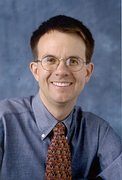
Nobel prize winner – dr. eric cornell Dr. Eric Cornell, senior scientist at the National Institute of Standards and Technology in Boulder, Colorado, garnered world attention recently when he won the 2001 Nobel Prize in Physics, together with two collaborators, for the achievement of Bose-Einstein condensation in dilute gases of alkali atoms, and for early fundamental studies of the properties of the condensates. While the science may be beyond the comprehension of many, the University of Colorado physics professors have attracted widespread attention in Taichung, given the fact that Cornell taught English in the city for about six months in 1982. In an exclusive interview, he took the time to share some memories and thoughts about his Taiwan experience with COMPASS Editor-in-Chief Douglas Habecker.
Q: Congratulations on winning the Nobel Prize. Here, in Taiwan and Taichung in particular, there was some pride that someone who once lived here had made such an achievement. What brought you to Taiwan and Taichung?
A: Back in those days, there was an organization out of Stanford University called Volunteers in Asia that set up teaching jobs in different places. I was an undergraduate at Stanford between my sophomore and junior years, taking a year off. College was rushing by and I felt I was rushing headlong into choices that were easy to make. I had had an interest in Chinese language, having taken a year in college, and in [Chinese] literature and politics. I was intrigued by that whole part of the world….I lived on Shihfu Road, half a block down from the Taichung Park from June to December, 1982. The YMCA set me up with conversational English classes, which were not very hard for me to teach. I also studied Chinese with a tutor at Tunghai University.
Q: What was your overall impression of Taichung and Taiwan as a whole during your time here? Are there any specific memories of Taichung that stand out to you?
A: I think it was a wonderful time in my life. I was doing something very different from the rest of my life. I was living an independent life….At the end of six months, I was ready to move on and did some traveling in China but I really enjoyed the time I was here. I remember going on YMCA-organized hiking trips as an honorary counselor with the kids. I don’t think Taichung is like this any more but there was explosive development that had left gaps, leaving blocks of rice paddies in the middle of the city. I found it very charming; that made a vivid impression. It was a novel experience to be a teacher in a residually Confucian society which meant I was more respected….There were very few foreigners in Taichung in 1982, other than a few other teachers I knew.
Q: How did your Chinese language studies go?
A: I had taken a year of Chinese in college and I was good at languages. By the time I left, I had no problem getting around. My big problem was with characters. I got to a first-grade reading level and could read bo-po-mo-fo comic books. I found that it was also easy to forget once I left it. I can still order in Chinese restaurants and there are a lot of Chinese students and scholars in physics. I occasionally try to impress them and they are always telling me how good my Chinese is, just like they did in Taiwan, which I know isn’t true.
Q: As unconnected as the two experiences may seem to be, did your time in Asia have any impact on your more recent accomplishments in science?
A: In a very indirect way, being in a foreign country at a relatively young age led to my self-confidence and independence to cut new ground in science and go with my instincts. You must be willing to cut new ground in science or you won’t go anywhere.
Q: Along these lines, what personal attitude or approach helped you win the Nobel Prize?
A: The key in physics is having imagination or, rather, a disciplined imagination grounded in what’s really out there. There are people who are very creative but physics goes in accordance to a strict set of rules. There are people who are also rule-bound and cannot think creatively. So it’s a balance between the two.
Q: Since your teaching days in Taichung, thousands of English teachers have come to work in Taiwan. There are those who make fun of teachers as people trying to find themselves or people without real jobs. What is your response?
A: That is often the case but I don’t think that that’s a slur against them. Back then hardly anyone made a career of it. I think travel is a wonderful thing and, even more, going somewhere and living there, soaking it up and having the experience of being an outsider. These experiences make you a more empathetic person to foreigners, to outsiders, to people who for any reason aren’t fitting in.
Q: Do you have any final words for the people of Taichung?
A: I’d like to say hello and best wishes to my many, many students and to the staff at the YMCA. I hope some of them remember me because I remember them…..I would very much like to return and visit Taichung again.


Comments
0 comments