

 taiwanfun
From our archives, Compass Magazine, Jan. 2002
Translated by Vicky Huang and Sharon Yang
Over the past decade, Jason Hu has become a well-known and widely-respected public figure in Taiwan as he has served his country in a variety of positions, including foreign minister, ROC representative to the United States, and director of the Government Information Office. Thanks to a decisive victory over his opponents in the December 1, 2001 mayoral election, this 53-year-old Oxford University graduate (Ph.d in philosophy) now finds himself as the head of Taiwan’s third-largest city. Mayor Hu recently took time from his busy schedule to share thoughts about his new job with COMPASS Editor-in-Chief Douglas Habecker. Below are excerpts from this exclusive interview.
C: You won the election by a very strong margin. Were you surprised by the margin of your victory?
H: I have to be honest and tell you I was not sure. When I first participated in the race, the DPP had a large, double-digit lead in the polls. That was back in January, 12 months ago. Then, by about April, May, June, I was tied up, very close [in the polls]. Then, after about July and August, I clearly began to lead. I heard people betting I would win by at least 30,000 votes but, at the same time, other people said it would be a small margin, within 10,000 votes, a few thousand votes. So, I was prepared for all possibilities.
C: If you were to attribute your victory to one main factor, one thing that really put you on top, what would it be?
H: I think there was not one, but two. Substance of policy presentation and my determination in running a clean, different campaign. I think these two things made me very different from the others….I don’t smear. Even when smeared, I don’t talk back. I don’t talk about irrelevant things. I didn’t put flags all around the city and asked others to do the same. At least Taichung became the only city in Taiwan in which you didn’t see flags in division islands of roads. I don’t give parties or meals. I don’t want to raise funds by having a lot of people eating and drinking. There are a lot of things I do which are quite different
C: You’ve served in a lot of positions, including foreign minister, representative to the United States, and head of the GIO. Are there any skills and experiences that you’ve gained in those jobs which will especially help you in your new Taichung position?
H: I think all along I’ve learned to look at things, not from my own perspective, but from the perspective of the people. This sounds like a cliche but I really began to think how other people were looking at things and this is how I gained respect and support at the GIO. I tried to look at things from your perspective–the press–from movie companies [perspectives], from all the things I was working to supervise. Instead, I began to work for them, not against them. I think that, all along, that kind of mentality has helped me. During the election, I’ve had to see things from other people’s perspectives and, as mayor, I will do the same thing. You are not there for youself. You are there for other people. Who are they? Those people walking on the street. You work for them, not yourself.
C: What would you say the biggest challenge facing you as mayor is?
H: At this moment, financial difficulty. This city is in debt, deep debt. It’s hard to think of an effective solution to solve that problem, that black hole….There are many ways to do this. You can issue bonds, but Taichung has already used up its upper limit for bonds. You can revise the law to raise that limit. That has to be done by the central government….You can turn to the central government and ask for help, but that’s not fully effective because they are also in debt. You can increase taxes locally but that’s a very limited option and not effective. You can also increase the attractiveness of city, make more people come and then receive more tax income and regain prosperity. With lots of people coming into the city, you have lots of money. Without lots of people, you have no money. But, without a special attraction, you cannot attract people. So, this is why I’ve been thinking of a Guggenheim Museum and all the other projects–an international conference center, exhibition center, making the city clean in every sense–anti-corruption and environmentally. Effective, friendly [government]–you have to have what I call a “sunshine government” with a big smile. You have to have business coming in. We’re talking about the third science park in central Taiwan. I say, yes, we need that but what about our industrial park? We have to solve their problems and stop them from moving to mainland China and other places.
C: What are the chances of getting a Guggenheim Museum here?
H: We have now starting “dating”. Marriage is along the way, I hope. I don’t know; it’s very hard to say. I’d like to say it’s very hopeful, but that doesn’t count. First, you have to have an agreement to start a feasibility study, then you have to have a feasibility study….So if actual construction and inauguration is the date of marriage, I am only prepared to say that, “Yes, we’re going to a movie together right now.” I think the Guggenheim is important. It will be the first in our part of the world…..I want to make Taichung famous for its cultural attractions and it has to be a melting pot between East and West. I also want Taichung to not just be a showcase of the past but of the future, and the Guggenheim is ideal for that because it has an international reputation for showing us the best in contemporary art. The fact that a full-fledged Guggenhim can be built in Taichung means that Taichung is on the cultural map of the global village, not just of Asia. Now, people would say this is a dream that is very difficult to materialize. All dreams are difficult. This is a small step hopefully leading to a giant step.
C: Going into this term, what will be your main focuses?
H: My major problem is financial difficulties but my main emphasis and concentration is to really regain prosperity for the city because, if you don’t have that, you don’t have anything. With prosperity regained gradually, you can improve law and order, have a better transportation system, a better living quality, a more modernized and civilized city. So, if you ask me about primary objectives, I’d say these four things–unemployment, law and order, anti-sex trade and transportation. These are the four major concerns of the people but, above all these four issues, you have this problem of prosperity. You have to regain economic momentum. With that regained, all of the other four will fall into place
C: If you were to picture Taichung in four years, what would be your image of this city?
H: I hope, within about three years, I do have the Guggenheim–you can see now that that’s the magic word–and Taichung would become a new cultural attraction in this part of the world, moving from the back burner to the front burner. Taipei has the Palace Museum but we have a considerable Guggenheim. First, you need to bring Taichung into the attention of people in the area. With Jason Hu elected, I think many people are beginning to look at Taichung but their patience is limited. If I don’t show them something within six months or 12 months, or a sign of hope within that reasonable, limited period of time, they will turn away. Five minutes before I walked in [today], a company in Taipei called me and said they were going to schedule a retailers’ conference in Taichung, an international retailers’ conference….I look foward to that. This is the kind of thing I need, international contacts and attention.
C: One of the things you’re best known for is your international experience. How do you plan to make Taichung a more international city?
H: You have to bring more foreign attention to Taichung to begin with and then, hopefully, bring them in person. And then, hopefully, you have to make Taichung attractive, both domestically and internationally. When I say domestically, I mean Chinese culture but not Chinese culture alone. With all these things gained, you then have to move from one leg to another. Culture is one leg. Business is the other. Traditionally, for the past 20, 30 years, Taichung has beeen famous for its cultural attractions and the fact that it is a business center in central Taiwan. Gradually, the past five years or so, we’ve lost both. People are not looking at Taichung for business opportunities. Neither would they look at Taichung for cultural attractions. I intend to work on these two but it is quicker to build up cultural attractions in two to three year’s time. At the same time, I would prepare infrastructure and ground work for business atrractions. I want business–multinationals–to come to Taichung to set up regional headquarters, to set up factories, or at least to come to Taichung for a visit or a regional meeting, or exhibition. There is a proposal to build a new world trade center or exhibition hall. I want something bigger than that. I want Taichung to have an exhibition hall facility as big as Taipei but better than Taipei’s. This is the age of urban competition. We used to talk about national competition, talk about the competitiveness of a state. Now we’re talking about the competitiveness of a city. We are competiing with–you never know–Bangkok, Singapore, Tokyo, Osaka, Seoul, Shanghai, Canton. Then you have to make yourself competitive. I hope that, within four years from now, Taichung will have regained its cultural attractions and begun to show its value as a clean, attractive business center.
C: What would you say to international and local businesses as they consider Taichung?
H: I would tell them that Taichung has one of the best climates in this part of the world–not dry, not wet, not cold, not too hot. It has one of the best housing situations, both in terms of quality and in terms of price. Thirdly, we are already not too far from an international airport, within two hours, but we have a major port within a 20-minute drive that has a lot of potential. We have the biggest airport in Asia, which is now military but will soon turn to civilian [use] within the next few years. We are strategically located versus mainland China. On a ferry boat, you can sail at night time from here and be in [Xiamen] in the morning. You can work for five days in [Xiamen] and spend the weekend with your family. This is why I said Taichung could become the home of the Taiwanese businessman in mainland China. There are all these, plus the fact I intend to build a clean, frendly, international government and the fact that the third science park will be built here. There’s a high-quality labor force, too. Taichung is only next to Taipei in terms of the educational level of the people. It’s higher than Kaohsiung.
C: For the international community that’s here right now–international businesses and business people–what would you say to them? Why should they stay here? Is there anything special you’d like to communicate to them?
H: I would like to tell them that I would like to do more for them. They should know that they’re very much in my concern, more than ever. I don’t think any other mayor would ever understand them that much. And, they are the symbol of my achievements if they stay. And the more they come, that means my intentions to internationalize this city–both culturally and commercially–are working. So, I will become much closer [to them]. I would like to build up more interaction and I’m always willing to listen.
C: You had the opportunities to serve elsewhere, including Taipei county, but you chose Taichung. What is it you personally like about Taichung?
H: Personally, I tell you, Taichung has potential. It’s a growing city. It has a certain kind of attraction that cannot be seen in either Taipei or Kaohsiung. Kaohsiung is too industrial; pollution is a serious problem. Taipei is too congested–over-development and the political climate there is too much for a lot of people. The friendliness of the people, growth potential of this city, very comfortable climate and living conditions are among the best in the world. Also, [Taichung] has one of the best mayors in the world. {He laughs.}
C: When you are not working, what do you do for relaxation?
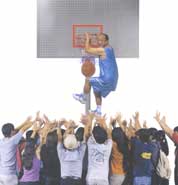
H: I read a lot–anything, all kinds of things. I listen to music a lot. I’m the kind of person that can turn on the radio and work at the same time, even when writing. I listen to all kinds of things; anything that pleases my ear I listen to. I’m not that kind of person who only listens to high-brow music. Language is no problem–anything that pleases my ear. Anything that pleases my mind, I read. I read more than 20, 30 magazines a week. I read 10 newspapers a day. I read a lot of books–on my radio program, I have a book review. Then I also play basketball. I’m not a party-goer. If I have the time, I always find a quiet corner and I stop talking. When I stop talking, that means I stop working.
C: Is there any particular part of Taichung you like to go to?
H: I’d say home but I don’t spend a lot of time there.




Comments
0 comments